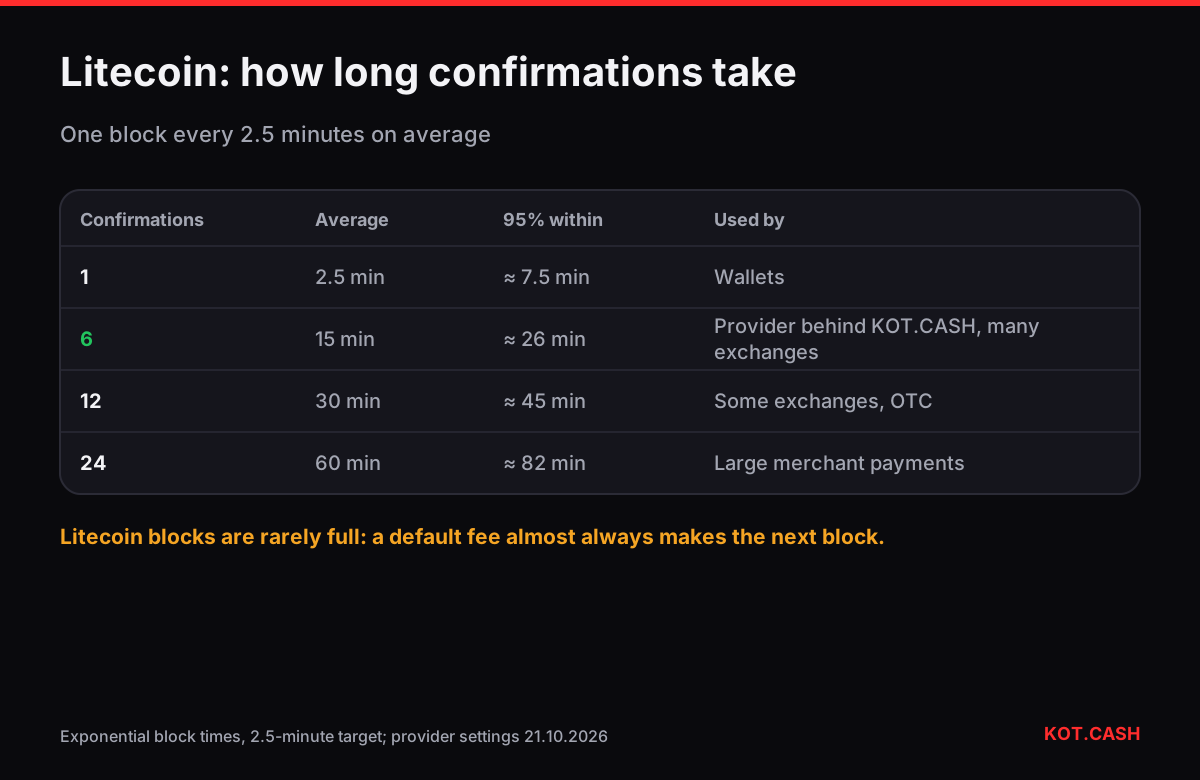
A Litecoin transaction usually gets its first confirmation within 2–5 minutes, because Litecoin targets one block every 2.5 minutes — four times as often as Bitcoin. Most recipients want more than one: the liquidity provider behind KOT.CASH credits LTC deposits after 6 confirmations, about 15 minutes on average, and some exchanges wait for 12, about half an hour. Litecoin blocks are rarely full, so a normal fee almost always makes the next block.
Confirmations and the time they take
Litecoin blocks arrive at random intervals just like Bitcoin's, only with a shorter average. The time to the next block follows an exponential distribution with a mean of 2.5 minutes; the time to n blocks is the sum of n such waits. The table shows what that means for typical thresholds.
| Confirmations | Average | 95% of the time within | Who waits for it |
|---|---|---|---|
| 1 | 2.5 min | ≈ 7.5 min | Wallets show the payment as confirmed |
| 6 | 15 min | ≈ 26 min | The provider behind KOT.CASH; many exchanges |
| 12 | 30 min | ≈ 45 min | Some exchanges and OTC desks |
| 24 | 60 min | ≈ 82 min | Cautious merchants for large sums |
The confirmation time estimator calculates the median and percentiles for any count, and the deposit confirmations lookup lists what the provider requires for 190 coins.
Why Litecoin is rarely stuck
Litecoin has the same block weight limit as Bitcoin — 4 million weight units — but much lower demand, and four times as many blocks. In practice blocks have spare room most of the time, and a transaction with the wallet's default fee is mined in the next block or the one after. Fees are a fraction of a cent for a typical transaction; the network fee comparison puts that next to other chains.
Stuck LTC transactions do happen, but almost always for one of these reasons: the wallet set a fee below the network's minimum relay fee (so nodes did not accept it), the wallet lost connection before broadcasting, or the transaction spends an output of another unconfirmed transaction that itself is stuck. A block explorer answers which: no record at all means not broadcast; 'unconfirmed' for an hour with a very low fee means the fee.
Difficulty adjustment and hashrate
Litecoin retargets difficulty every 2,016 blocks, about 3.5 days. If hashrate jumps or falls sharply between adjustments, blocks come faster or slower than 2.5 minutes for a few days. Litecoin is merge-mined with Dogecoin, so most of its hashrate comes from large Scrypt pools that mine both chains at once; that has kept block times stable in recent years.
MWEB transactions
Payments inside MWEB, Litecoin's optional privacy extension, are included in the same 2.5-minute blocks. Moving coins into MWEB (peg-in) and back out (peg-out) are separate transactions with their own confirmations. Exchanges and swap providers send and receive regular Litecoin transactions, so for deposits and payouts MWEB timing does not apply — give them a regular ltc1, L or M address.
What slows LTC down outside the network
- Exchange withdrawals. The exchange may batch LTC withdrawals or hold them for review. No hash means it has not been sent yet.
- Higher confirmation counts. An exchange that waits for 12 or more blocks shows a deposit as 'pending' for half an hour even though the network finished its part long ago.
- Address format checks. Old 3… P2SH addresses are rejected by many services; the withdrawal fails or never starts.
- Wallet sync. Light wallets that have not synced show stale balances. Refresh or reconnect before assuming a payment is missing.
LTC in a swap
When you send LTC to an LTC to USDT order, the order page counts the 6 confirmations; expect about 15 minutes, occasionally 25–30. When you receive LTC from a USDT to LTC order, the payout is usually in a block within a few minutes of being sent. The Litecoin side is fast enough that many people use it as the 'quick' leg of a longer route.
FAQ
How long does a Litecoin transaction take?
Usually 2–5 minutes to the first confirmation. Six confirmations take about 15 minutes on average.
How many confirmations does an LTC deposit need?
The provider behind KOT.CASH waits for 6. Exchanges set their own numbers, typically 3 to 12.
Why is my Litecoin transaction unconfirmed?
Usually the fee is below the minimum relay fee or the transaction was never broadcast. Check it in a block explorer.
Is Litecoin faster than Bitcoin?
Its blocks are four times as frequent (2.5 vs 10 minutes), so the same number of confirmations takes a quarter of the time.
Do MWEB transactions take longer?
They use the same blocks. Peg-in and peg-out are separate transactions that each need confirmations.