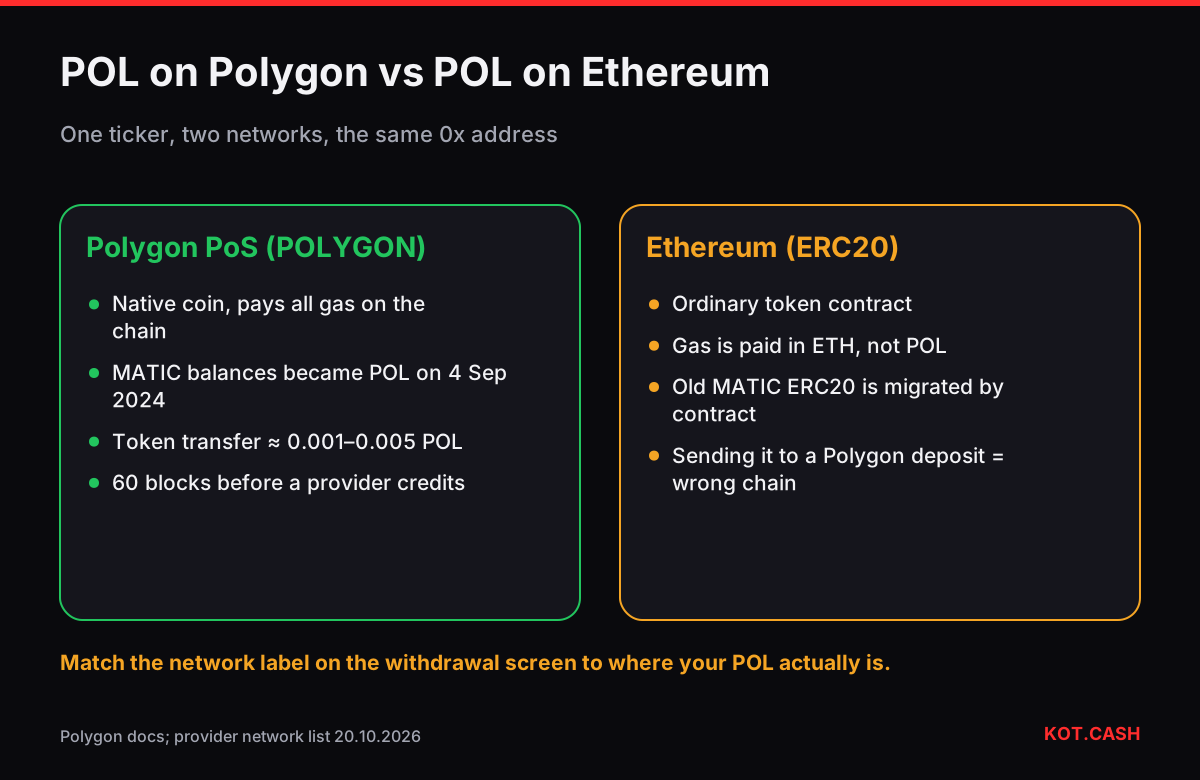
Gas on Polygon PoS is paid in POL. MATIC, the old gas token, was replaced on 4 September 2024: balances on Polygon PoS were switched to POL one-to-one automatically, and the gwei numbers you see in wallets now refer to POL. A token transfer on Polygon typically costs a small fraction of a POL — well under a cent to a few cents in dollars. The traps are elsewhere: POL also exists as an ERC20 token on Ethereum, wallets show large gwei numbers that look alarming, and tokens without POL for gas cannot move.
What changed from MATIC to POL
Polygon's upgrade made POL the native token of Polygon PoS. On the PoS chain itself nothing had to be done: every MATIC balance became the same amount of POL, and gas started being charged in POL. On Ethereum, where MATIC and POL are ordinary ERC20 tokens, MATIC holders can migrate to POL through the official migration contract; exchanges handled it for their users. Old guides that mention “MATIC for gas” are describing the same thing under the old name.
| Where | What it is | Pays gas? |
|---|---|---|
| POL on Polygon PoS | Native coin of the chain | Yes, on Polygon |
| POL on Ethereum (ERC20) | Token contract on Ethereum | No — ETH pays gas there |
| MATIC on Ethereum (ERC20) | Legacy token, migratable to POL | No |
| MATIC on Polygon PoS | Became POL in September 2024 | — |
The liquidity provider used by KOT.CASH lists POL on two networks: POLYGON (Polygon PoS, native coin) and ERC20 (the Ethereum token). Choosing the wrong one on a withdrawal screen sends coins to a different chain, so match the network label to where your wallet actually holds POL.
How much a Polygon transaction costs
Polygon PoS uses the EIP-1559 fee model like Ethereum: base fee + tip, multiplied by gas used. Gas usage is identical to Ethereum — 21,000 for a native transfer, roughly 45,000–65,000 for USDT or USDC. What differs is the scale of prices: Polygon enforces a minimum priority fee measured in tens of gwei, and the base fee is usually in the same range. Thirty or eighty gwei sounds expensive if you are used to Ethereum, but it is gwei of POL, a coin worth a small fraction of ETH.
Worked example: 60,000 gas for a USDT transfer at a total of 60 gwei is 3,600,000 gwei = 0.0036 POL. With POL priced well below a dollar, that is a fraction of a cent. During heavy activity the base fee can jump to hundreds of gwei for a while, and a transfer may cost a few cents. The gas fee calculator takes any gas price and POL price you type.
Common Polygon mistakes
- Withdrawing USDT on Polygon to a wallet with no POL. The tokens arrive but cannot be sent. Withdraw a little POL on the POLYGON network as well.
- Setting a tip below the network minimum. Some wallets let you edit the priority fee freely. Transactions with a tip under the minimum are not picked up and stay pending.
- Confusing USDC and USDC.e. Polygon has native USDC issued by Circle and older bridged USDC.e. They are different tokens with different contracts; a receiving service may support only one.
- Sending POL ERC20 to a Polygon-only deposit. Ethereum and Polygon share the 0x address format, so the address looks right, but the coins are on a different chain.
- Waiting for a deposit too early. Polygon blocks are fast, but receiving services wait for more confirmations than on many chains.
Confirmations and timing
Polygon PoS produces a block roughly every two seconds. Since a 2024 upgrade the chain also reaches finality much faster than before, but services still apply their own safety margin. The swap provider behind KOT.CASH waits for 60 Polygon blocks before crediting a deposit, which is a couple of minutes. A USDC on Polygon to USDC on Ethereum swap, for example, typically finishes in a few minutes plus the Ethereum payout.
You can look up confirmation counts for every coin and network in the deposit confirmations table.
Polygon PoS is not the only Polygon
Polygon also built a zk-rollup, Polygon zkEVM, and the AggLayer project; those are separate networks with their own gas rules. When a guide or an exchange says “Polygon” it almost always means Polygon PoS. Check the chain ID in your wallet if unsure: Polygon PoS mainnet is chain ID 137.
For swaps the distinction matters less than for withdrawals: on KOT.CASH you choose the coin and the network explicitly, and the order page repeats the network next to the deposit address. If the label says POLYGON, send from Polygon PoS; if it says ERC20, send from Ethereum and pay the gas in ETH.
FAQ
Is Polygon gas paid in MATIC or POL?
In POL since 4 September 2024. Balances on Polygon PoS were converted automatically one-to-one.
Why does my wallet show 30–100 gwei on Polygon?
Polygon enforces a minimum tip in the tens of gwei, and these are gwei of POL, which is cheap. The fee in dollars is usually under a cent.
Can I send POL from Ethereum to a Polygon address?
Only through a bridge or a swap that changes the network. A direct ERC20 transfer stays on Ethereum.
How many confirmations does a Polygon deposit need?
The provider behind KOT.CASH waits for 60 Polygon blocks, a couple of minutes.
Do I need POL to receive tokens on Polygon?
No. Only the sender pays gas. You need POL to send them afterwards.