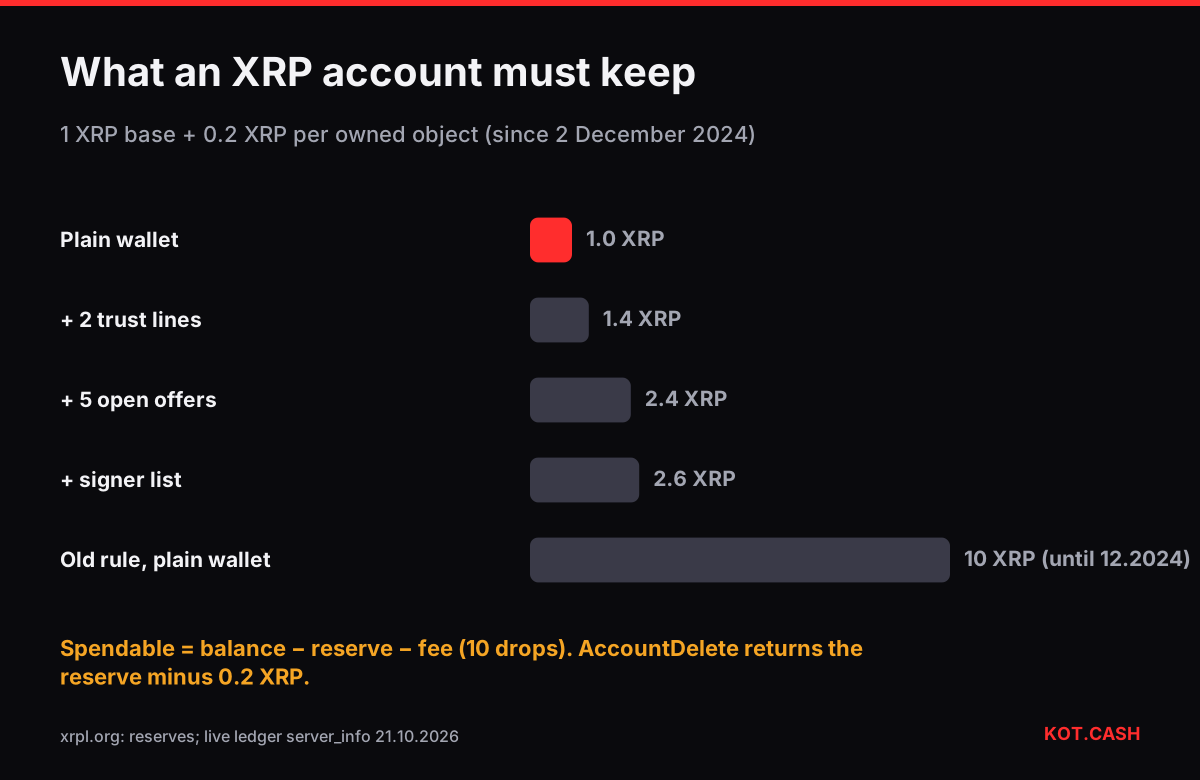
Every account on the XRP Ledger must keep a minimum balance called the reserve: a base reserve of 1 XRP plus an owner reserve of 0.2 XRP for every object the account owns, such as a trust line or an open offer. These values have been in force since 2 December 2024, when validators voted them down from 10 XRP and 2 XRP; the live ledger still reports reserve_base_xrp = 1 and reserve_inc_xrp = 0.2 on 21 October 2026. The reserve is the reason your wallet will not let you send the whole balance, and the reason a payment to a brand-new address must be at least 1 XRP.
How the reserve is calculated
reserve = 1 XRP + 0.2 XRP × number of owned objects
spendable = balance − reserve − transaction fee
Owned objects include trust lines (needed to hold tokens such as RLUSD or other issued currencies), open DEX offers, escrows, payment channels, checks, tickets, signer lists and NFT pages. A plain wallet with no objects has a reserve of exactly 1 XRP. The XRP reserve calculator adds up the reserve for any mix of objects.
| Account | Owned objects | Reserve | Spendable from 25 XRP |
|---|---|---|---|
| Plain wallet | 0 | 1 XRP | ≈ 24 XRP |
| Wallet with 2 trust lines | 2 | 1.4 XRP | ≈ 23.6 XRP |
| Trader with 5 open offers and 3 trust lines | 8 | 2.6 XRP | ≈ 22.4 XRP |
| Account with a signer list and 10 NFT pages | 11 | 3.2 XRP | ≈ 21.8 XRP |
Activating a new XRP address
An XRP address exists on the ledger only after it receives at least the base reserve. If you send less than 1 XRP to an address that has never been funded, the transaction fails with the result code tecNO_DST_INSUF_XRP and only the small network fee is spent. This often surprises people who withdraw a small amount from an exchange to a newly created wallet: send at least 1 XRP the first time, ideally a bit more so the wallet can pay fees and hold a trust line or two.
- First deposit to a new wallet: at least 1 XRP, more if you plan to add trust lines.
- Wallets like Xaman show the reserve as a locked part of the balance.
- The reserve is not a fee and is not spent; it simply cannot leave the account while the account exists.
Fees are tiny and burned
The base transaction cost on the XRP Ledger is 10 drops (0.00001 XRP). It is destroyed, not paid to anyone. The cost rises temporarily under load, but for everyday payments it stays at a few drops — far below a hundredth of a cent. Because of that, a failed payment costs practically nothing; what matters is the reserve and the destination tag.
Freeing the reserve
- Remove objects you do not need. Cancel open offers, remove trust lines with a zero balance, finish or cancel escrows. Each removed object frees 0.2 XRP.
- Delete the account. The AccountDelete transaction sends all remaining XRP, including the base reserve, to another account. It costs a special fee equal to one owner reserve (currently 0.2 XRP), the account must own no objects that block deletion, and its sequence number must be at least 256 lower than the current ledger index, so a just-created account has to wait a few minutes.
- After deletion the address can be funded again later, but it starts from scratch.
Reserve vs destination tag
Two different things trip up XRP users. The reserve concerns your own account. The destination tag concerns shared addresses: exchanges and swap services receive XRP for many users on one address and tell deposits apart by the tag. When you send XRP to a KOT.CASH swap, the order page shows the deposit address and the destination tag next to it — copy both. The memo and tag checker lists every coin that needs one.
XRP swaps on KOT.CASH
The liquidity provider credits XRP deposits after one ledger validation — a few seconds. When you receive XRP as a payout to a wallet that does not exist yet, the amount must be at least 1 XRP or the payout would fail; check the quote for small swaps. The payout network fee is included in the quote (about 0.2 XRP for USDT to XRP at the moment). Routes: XRP to USDT and XRP to BTC.
Why the XRP Ledger has a reserve at all
Every object stored in the ledger has to be kept by every server, forever, until someone deletes it. Without a cost, it would be cheap to create millions of empty accounts or junk offers and bloat the shared state. The reserve makes each stored object cost a small amount of XRP for as long as it exists, which keeps the ledger compact while leaving payments themselves almost free. Validators can vote on the reserve values, which is how they came down from 20 XRP originally to 10 XRP in 2021 and to 1 XRP in December 2024 as the XRP price rose.
For users this means two numbers to remember: send at least 1 XRP to activate a new address, and expect about 0.2 XRP to be locked for each token you hold through a trust line.
FAQ
What is the XRP reserve now?
1 XRP base reserve plus 0.2 XRP for each owned object, since 2 December 2024.
Why can't I send all my XRP?
The reserve must stay in the account. You can send the balance minus the reserve and the fee, or delete the account with AccountDelete.
What does tecNO_DST_INSUF_XRP mean?
You tried to send less than the base reserve to an address that has not been activated. Send at least 1 XRP.
Do I get the reserve back?
Yes: removing objects frees 0.2 XRP each, and AccountDelete returns the rest minus a 0.2 XRP deletion fee.
Do I need a destination tag when sending XRP to KOT.CASH?
Yes, when the order page shows one. Copy the address and the tag exactly.