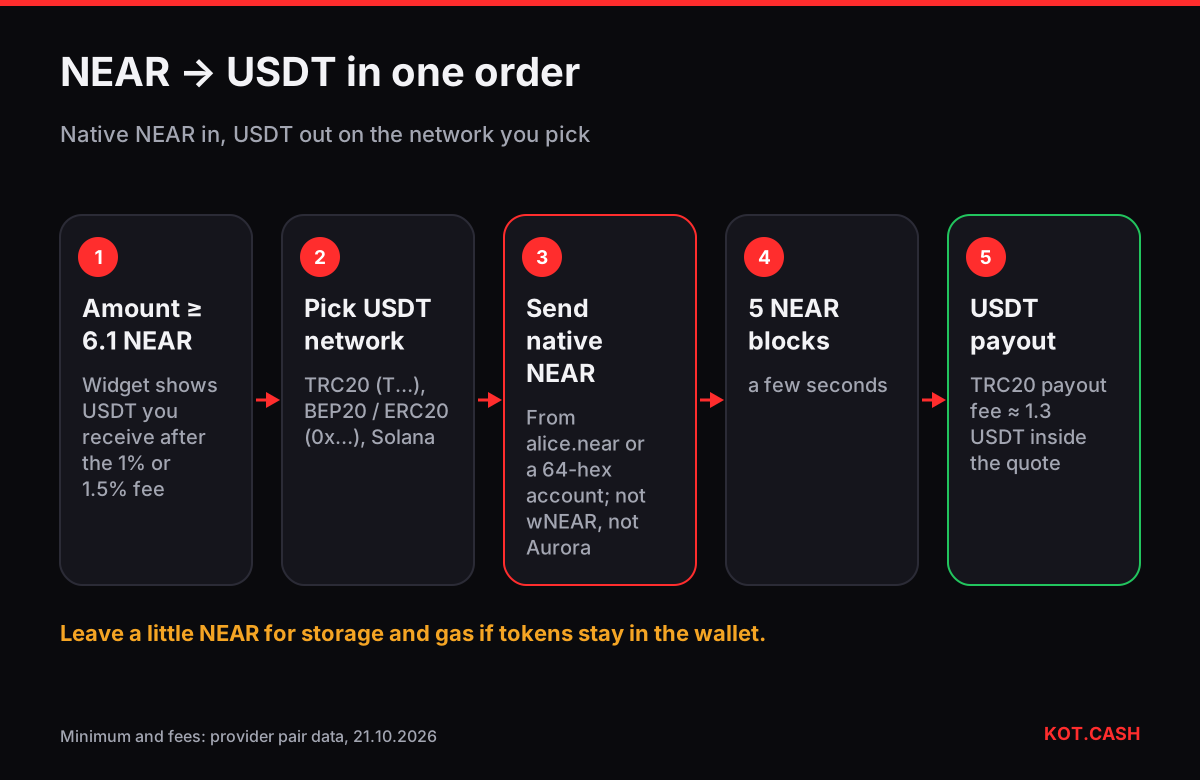
Swapping NEAR to USDT takes one order: you send native NEAR from your NEAR account to the deposit shown on the NEAR to USDT page and receive USDT on the network you choose — TRC20, ERC20, BEP20, Solana and others. The current minimum is about 6.1 NEAR, the provider waits for only 5 NEAR blocks, and the deposit side is done in seconds. What needs attention is the NEAR account model, which differs from Bitcoin and Ethereum.
NEAR accounts: names and long hex addresses
A NEAR account can look like alice.near — a human-readable named account — or like a 64-character hexadecimal string, an implicit account derived directly from a public key. Since 2024 there are also ETH-style implicit accounts (0x… addresses) created by wallets that support NEAR's EVM compatibility layer. All three hold the same native NEAR coin.
For the swap you only send from your account, so any of these types works. Two things to know: an implicit account does not exist on-chain until it receives its first NEAR, and a named account has to be created (and paid for) by someone. Neither matters for sending, but both explain why a brand-new wallet can show an address with no history.
Keep a little NEAR for storage and gas
NEAR charges for the bytes an account occupies on-chain through storage staking: roughly 1 NEAR is locked for every 100 KB of data. A plain account needs a tiny fraction of that, but accounts holding many tokens or contract data lock more. The locked part cannot be sent. Your wallet usually shows it as reserved for storage; send the available balance minus a small gas reserve, not the total.
Gas on NEAR is cheap — a transfer costs a small fraction of a cent — but it is paid in NEAR. If you plan to keep NEP-141 tokens (USDT or USDC on NEAR, for example) in the same wallet, leave 0.05–0.1 NEAR so you can move them later.
Which USDT to receive
| Network | Payout network fee (provider) | Good for |
|---|---|---|
| TRC20 (TRON) | ≈ 1.3 USDT | Exchanges and wallets that use TRON |
| BEP20 (BSC) | low | MetaMask, Trust Wallet, BSC DeFi |
| ERC20 (Ethereum) | higher, follows gas | Large amounts, Ethereum DeFi |
| Solana | low | Phantom, Solana apps |
The provider quotes about 1.3 USDT as the TRC20 payout fee for this pair. The figure is already inside the widget quote. If the destination is an exchange account, use the network that exchange lists for USDT deposits; if it is your own wallet, choose the one where you will spend or move the USDT next. The stablecoin fee comparison helps when you are unsure.
The order step by step
- Enter the amount of NEAR. If the widget says the amount is below the minimum, add enough to clear it — it is about 6.1 NEAR now.
- Choose the USDT network and paste a receive address from that network. A TRC20 address starts with T, BEP20 and ERC20 with 0x.
- Choose a floating rate (1% service fee) or a fixed rate (1.5%).
- Create the order and send NEAR from your wallet to the deposit account shown on the order page. NEAR deposits do not need a memo with this provider.
- Five NEAR blocks pass in a few seconds. The provider's processing estimate is 1–2 minutes, then the USDT payout follows.
Checking the deposit yourself
Every NEAR transaction has a hash you can open in NearBlocks or the NEAR Explorer. A transfer on NEAR is executed as receipts, and the explorer shows each one: the transfer receipt and the refund of unused gas to your account. A status of Succeeded on the transfer receipt means the deposit account has your NEAR. If the receipt failed — usually because the amount plus gas exceeded the spendable balance — the NEAR never left, and the order keeps waiting until it expires.
On the USDT side, the order page shows the payout hash. A TRC20 payout is visible in Tronscan within seconds; a Solana payout in Solscan; BEP20 in BscScan. If you want a quick reminder of how to read those pages, see how to check a transaction by hash.
Swap or exchange account?
On a centralised exchange, selling NEAR means depositing it, placing a NEAR/USDT order and withdrawing USDT — three steps, an identity-verified account, and a flat withdrawal fee. The swap combines those into one order without an account. For a one-off conversion of a few hundred dollars the difference is mostly convenience; for frequent trading an exchange account with low trading fees can be cheaper. Compare both with your own numbers in the swap fee calculator.
Common snags
- Sending a NEAR token instead of NEAR. wNEAR (wrapped NEAR) is a token contract, not the native coin. Unwrap it in your wallet first.
- Sending from an exchange that batches withdrawals. Some exchanges send NEAR via a function call from a hot wallet. That is normal; the deposit counts once the transfer lands.
- Sending NEAR on Aurora or as a bridged token on another chain. The deposit expects native NEAR on NEAR Protocol. Tokens on Aurora, BSC or Ethereum are different assets.
- Typing a named account by hand.
alice.nearandalice-near.nearare different accounts. Copy addresses; never retype them.
FAQ
What is the minimum NEAR to swap?
About 6.1 NEAR at the time of writing. The widget shows the current minimum, which changes with network costs.
Do I need a memo to send NEAR?
No. For this provider the NEAR deposit is identified by the deposit account alone.
Can I send from a .near named account?
Yes. Named and implicit accounts hold the same native NEAR, and both can send to the deposit.
How long does NEAR to USDT take?
The NEAR side takes seconds. Processing is usually 1–2 minutes, and the USDT payout confirms on its own network, a minute or so on TRON.
Why can't I send my whole NEAR balance?
Part of it is locked for storage staking and part is needed for gas. Wallets show the spendable amount separately.