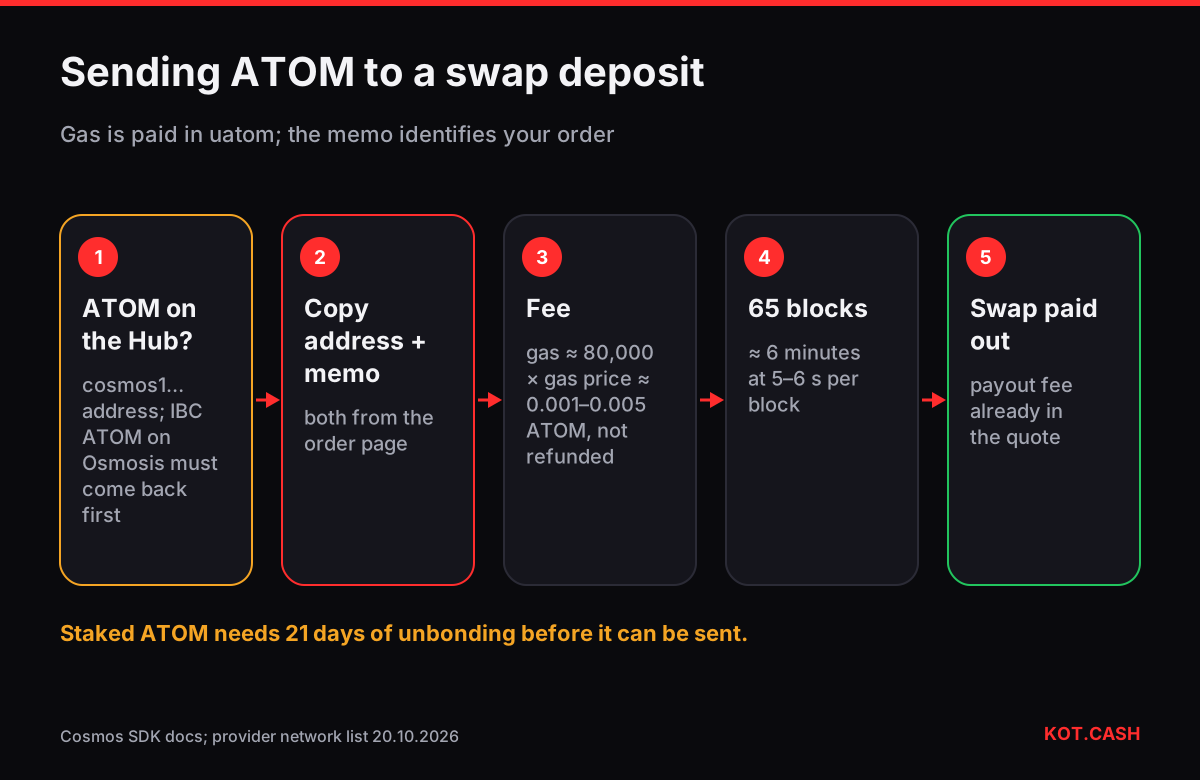
A transfer on the Cosmos Hub costs a few thousandths of an ATOM. Like other Cosmos SDK chains, the Hub charges gas used × gas price, paid in uatom — micro-ATOM, where 1 ATOM = 1,000,000 uatom. A simple send uses roughly 70,000–100,000 gas, and validators only accept transactions that pay at least the chain's minimum gas price. Wallets such as Keplr and Leap show three presets (low, average, high) and calculate everything for you. The two things that cost ATOM holders real money are not fees: a missing memo on an exchange deposit and sending IBC-wrapped ATOM from another chain to an address that expects native ATOM.
How the fee is built
When your wallet prepares a transaction it simulates it, multiplies the gas estimate by a safety factor, and attaches a fee of gas limit × gas price. Unlike Ethereum, Cosmos SDK chains do not refund unused gas: you pay the fee you attached, whether or not the transaction used all the gas. This is why wallets do not inflate the gas limit as much as EVM wallets do.
fee (uatom) = gas limit × gas price (uatom per gas)
1 ATOM = 1,000,000 uatom
The minimum gas price is a chain parameter. The Cosmos Hub added a fee market module that adjusts the minimum price with demand, so the floor can rise during heavy usage and fall back afterwards. Wallets read the current value from the chain; if you set a custom fee below it, the transaction is rejected immediately with an “insufficient fee” error and nothing is charged.
| Action | Gas used | Fee at a typical price |
|---|---|---|
| ATOM send | ≈ 80,000 | ≈ 0.001–0.005 ATOM |
| Delegate to a validator | ≈ 200,000 | ≈ 0.003–0.01 ATOM |
| Claim staking rewards | ≈ 150,000–300,000 | ≈ 0.003–0.01 ATOM |
| IBC transfer out | ≈ 120,000–150,000 | ≈ 0.002–0.008 ATOM + fee on the other chain |
The memo: why ATOM deposits need one
Cosmos addresses (cosmos1…) belong to one key, and exchanges and swap services usually receive ATOM for many customers on a single address. They tell deposits apart by the memo, a free-text field attached to the transaction. The liquidity provider behind KOT.CASH lists ATOM with a memo; when you create an ATOM order, the order page shows the deposit address and a memo — copy both. Without the memo the coins arrive at the right address but cannot be matched to your order automatically, and recovery takes manual work. Your own wallet address does not need a memo; leave the field empty when receiving to yourself.
IBC: same ticker, different place
IBC lets ATOM move to other Cosmos chains such as Osmosis or Neutron. On those chains ATOM is represented as an IBC denomination (ibc/27394FB…), and the address prefix is different: osmo1…, neutron1…. Two consequences follow:
- An IBC transfer costs gas on the sending chain, and the relayer delivers it to the destination; a timeout returns the tokens if the packet is not delivered in time.
- ATOM sitting on Osmosis is not on the Cosmos Hub. To deposit it to a service that expects native Hub ATOM, first send it back over IBC to your cosmos1… address, then send from the Hub with the memo.
- Some wallets can do both steps in one action, but the service still sees a transfer from the Hub — check the network label on the deposit page.
Fees vs staking economics
Fees on the Hub are small compared with staking rewards, so they rarely affect decisions. What matters more for liquidity is the 21-day unbonding period: undelegated ATOM cannot be transferred until it ends. If you plan to swap staked ATOM, start unbonding three weeks ahead. The unbonding period lookup lists unbonding times for other networks too.
ATOM on KOT.CASH
The provider credits ATOM deposits after 65 confirmations. The Cosmos Hub produces a block roughly every five to six seconds, so the wait is about six minutes; the order shows processing time accordingly. The minimum for ATOM to USDT is currently about 17 ATOM, and for USDT to ATOM the payout network fee in the quote is about 0.005 ATOM. When receiving ATOM as a payout, use your own cosmos1… wallet address: the standard swap form does not have a payout memo field, so a payout to an exchange that requires a memo would arrive without one. Routes: ATOM to USDT and USDT to ATOM.
FAQ
How much is a Cosmos ATOM transaction fee?
Usually a few thousandths of an ATOM for a send: gas of about 80,000 times the current gas price in uatom.
What is uatom?
Micro-ATOM: one millionth of an ATOM. Fees and balances on chain are stored in uatom.
Do I need a memo to send ATOM to KOT.CASH?
Yes. Copy the deposit address and the memo shown on the order page.
Is unused gas refunded on Cosmos?
No. Cosmos SDK chains charge the fee you attached regardless of actual usage.
Can I send ATOM from Osmosis directly to a swap deposit?
Not as native ATOM. Send it back over IBC to your Cosmos Hub address first, then deposit from there with the memo.