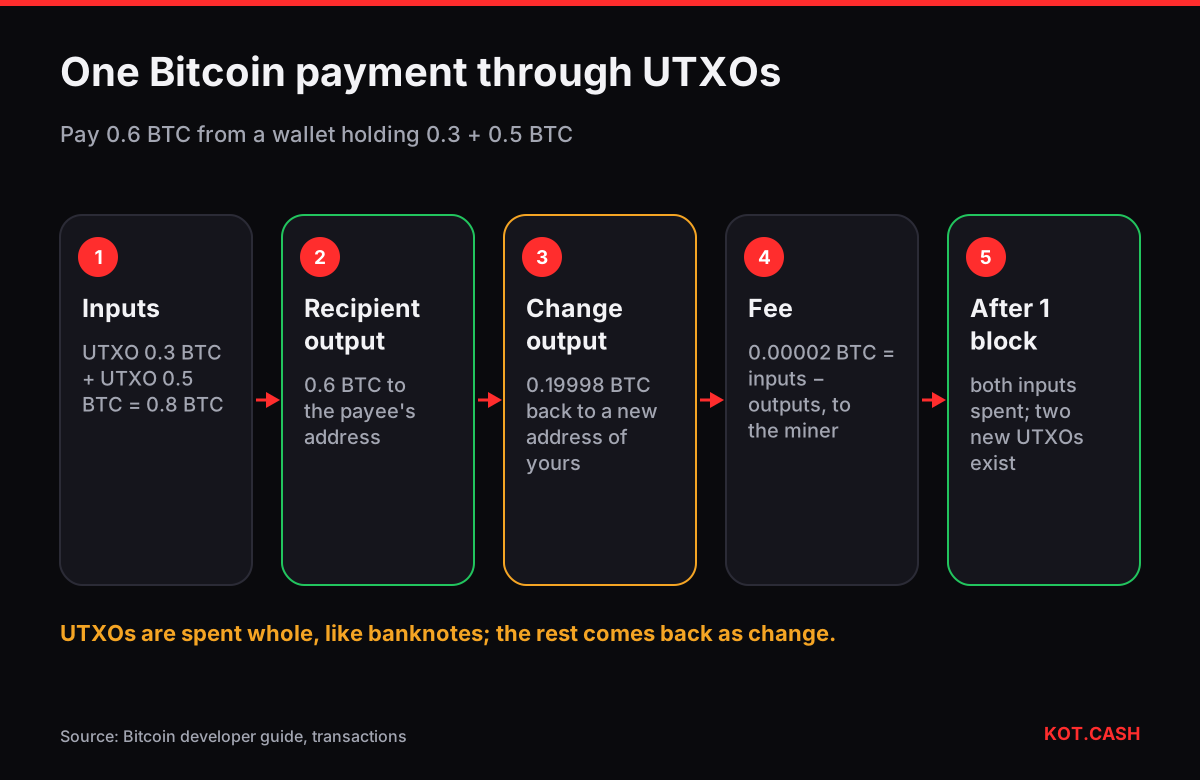
A UTXO, unspent transaction output, is a discrete piece of bitcoin locked to an address that has not been spent yet. Bitcoin has no account balances on chain. Your wallet's balance is the sum of all UTXOs it can spend. When you send a payment, the wallet picks whole UTXOs as inputs, pays the recipient in one new output, and returns the rest to you in a change output. Litecoin, Dogecoin, Bitcoin Cash and Cardano (in an extended form) work the same way.
A payment, step by step
Say your wallet holds two UTXOs: 0.3 BTC and 0.5 BTC. You want to pay 0.6 BTC.
- Neither UTXO is big enough alone, so the wallet uses both as inputs: 0.8 BTC in total.
- It creates an output of 0.6 BTC to the recipient's address.
- It creates a change output back to a new address of yours for 0.8 − 0.6 − fee.
- The difference between inputs and outputs is the fee the miner collects. With a fee of 0.00002 BTC, change is 0.19998 BTC.
- After confirmation, both old UTXOs are spent and cannot be used again. You now own one UTXO of 0.19998 BTC; the recipient owns one of 0.6 BTC.
UTXOs are spent whole, like banknotes. You cannot spend half of a UTXO; you spend it and take change. That is why a block explorer shows your payment going to two addresses, one of which is yours.
Why input count drives the fee
Bitcoin fees are paid per virtual byte, and each input adds size: about 68 vB for a native SegWit input, 57.5 vB for Taproot, 148 vB for a legacy input. Outputs are smaller, around 31 to 43 vB. A payment that spends ten small UTXOs can cost several times more than one that spends a single large UTXO, even if the amount is the same. The Bitcoin transaction fee calculator shows the size of different shapes, and this guide on input count works through real examples.
Dust and consolidation
When fees rise, small UTXOs can become uneconomic: spending a 1,000-satoshi UTXO that adds 68 vB costs 680 sats at 10 sat/vB, most of its value. Below the dust limit, which depends on the output type, nodes will not relay a transaction that creates such an output at all. The dust limit calculator shows the thresholds and whether a UTXO is worth spending at a given fee rate.
Consolidation is the habit of combining many small UTXOs into one when fees are low, typically at weekends or quiet periods, so future payments need fewer inputs. It costs a fee now to save larger fees later. The UTXO consolidation calculator finds the break-even fee rate.
UTXO vs account model
| UTXO model | Account model | |
|---|---|---|
| Examples | Bitcoin, Litecoin, Dogecoin, Cardano | Ethereum, BNB Chain, TRON, Solana |
| State | set of unspent outputs | balance per address |
| Payment | spend outputs, create new ones | debit one balance, credit another |
| Ordering | by which outputs are spent | by account nonce |
| Change | explicit change output | none |
| Fee driver | transaction size in bytes | computation (gas, energy) |
In the account model there is no change: sending 0.6 ETH from a 0.8 ETH balance simply leaves 0.2 ETH minus the fee. Ordering comes from the account nonce instead.
UTXOs beyond Bitcoin
Cardano uses an extended UTXO model: each output can carry native tokens and data for smart contracts, not just ADA. Every such output must hold a minimum amount of ADA that grows with its size, which is why sending tokens on Cardano always moves some ADA along with them; the details are in the Cardano minimum ADA guide. Litecoin and Dogecoin copy Bitcoin's model closely, so inputs, change and fees behave the same way, only with different coin values and block times.
Privacy: what UTXOs reveal
Spending several UTXOs together is a strong hint to chain analysts that they belong to the same owner, the common-input-ownership heuristic. Change outputs can often be identified by their amount or address type. That is why wallets generate a new address for every receipt and change output, and why consolidating UTXOs from different sources links them together. For more on how this differs from Monero, see Bitcoin vs Monero transparency.
UTXOs and swaps
When you send BTC or LTC to a KOT.CASH deposit address, the provider waits for the transaction that creates a UTXO at that address to confirm; the number of confirmations required is shown in the deposit confirmations table. If your wallet has many small UTXOs, the deposit transaction will be larger and need a higher fee to confirm quickly. A wallet with coin control, such as Sparrow or Electrum, lets you choose which UTXOs to spend.
FAQ
What does UTXO stand for?
Unspent transaction output: an output of a past transaction that has not yet been spent and can be used as an input.
Why does my Bitcoin payment go to two addresses?
One is the recipient; the other is your change address receiving the remainder of the inputs you spent.
Do more UTXOs mean higher fees?
Yes. Each input adds bytes to the transaction, and fees are paid per virtual byte.
What is UTXO consolidation?
Combining many small UTXOs into one in a low-fee period so later payments need fewer inputs.
Does Ethereum use UTXOs?
No. Ethereum uses the account model with balances and nonces per address.