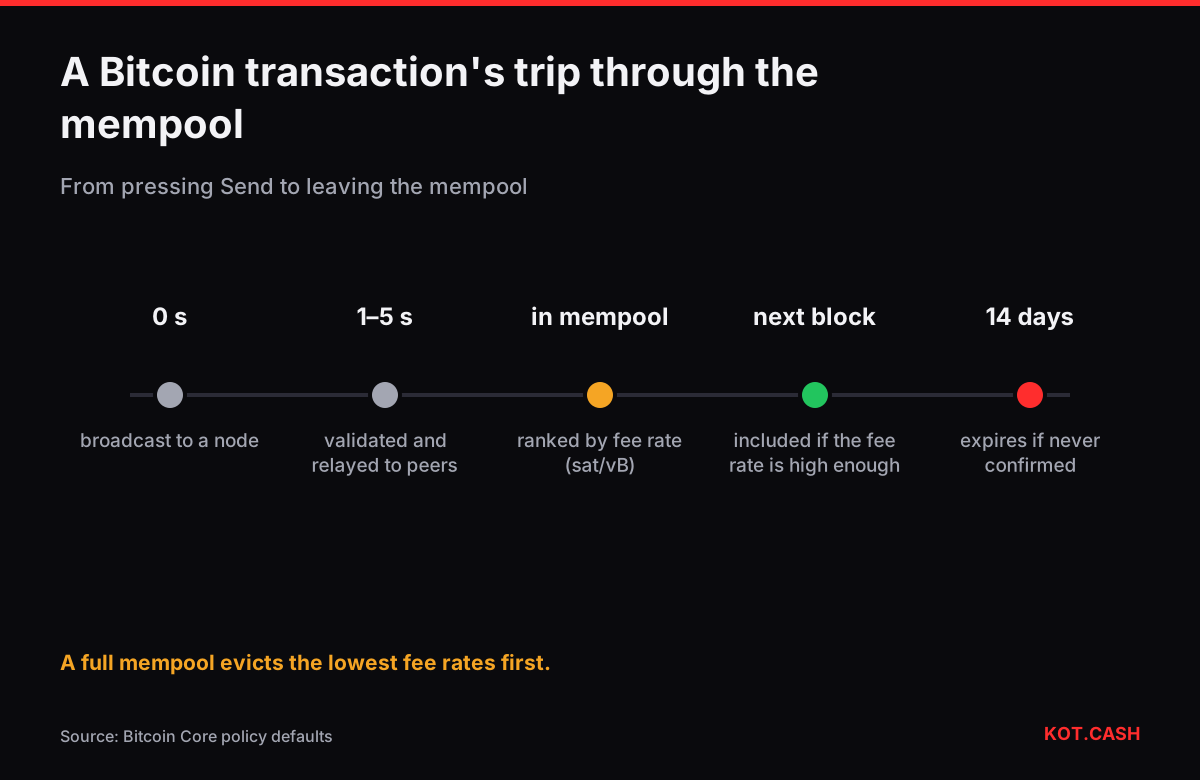
The mempool, short for memory pool, is the set of valid transactions a node has received but that are not yet in a block. Each node keeps its own mempool in memory, so there is no single global one, but well-connected nodes see nearly the same set. When a miner or validator builds a block, it picks transactions from its mempool, usually the ones paying the highest fee per unit of block space. Your transaction sits in the mempool from the moment you press send until it is confirmed, replaced or dropped.
The life of a transaction
- Broadcast. Your wallet sends the signed transaction to one or more nodes.
- Validation. Each node checks signatures, that the inputs exist and are unspent (or that the nonce and balance are right on Ethereum), and that the fee meets its minimum relay policy.
- Propagation. Valid transactions are relayed peer to peer and appear in mempools across the network within seconds.
- Selection. Block producers choose transactions, highest fee rate first, up to the block size or gas limit.
- Confirmation. The transaction is in a block and leaves the mempool. Each further block adds a confirmation.
Why fee rate decides the queue
Block space is limited. In Bitcoin a block holds up to 4 million weight units, roughly 1 million virtual bytes. If the mempool holds more than one block's worth of transactions, miners take the best-paying ones and the rest wait. What matters is the fee rate in sat/vB, not the total fee: a large transaction paying 5,000 sats can rank below a small one paying 2,000 sats. Sites like mempool.space show the mempool sorted by fee rate as projected blocks; how to use mempool.space explains how to read them, and this guide shows how to pick a rate.
Mempool limits: how transactions drop out
| Setting | Default | Effect |
|---|---|---|
| Maximum mempool size | 300 MB | lowest fee-rate transactions are evicted when full |
| Expiry | 336 hours (14 days) | unconfirmed transactions are removed after two weeks |
| Minimum relay fee | set by node policy | below it, the node will not accept or relay |
| Replace-by-fee | allowed by default | a higher-fee replacement can take a transaction's place |
When a node's mempool is full, it raises its minimum fee and evicts the cheapest transactions. A low-fee transaction can therefore disappear from many nodes during a busy period, and the wallet may show it as pending while the network has forgotten it. After 14 days it expires by default. The coins were never spent, so they are back in your wallet once it notices; see what to do when a transaction is dropped.
Getting a stuck transaction moving
- Replace-by-fee (RBF). Send a new version of the transaction with a higher fee rate. The replacement must pay more in absolute terms and per vbyte.
- Child-pays-for-parent (CPFP). If you are the recipient, or the transaction has change to you, spend that output with a high fee. Miners include both to collect the combined fee.
- Wait. Mempools usually clear at weekends or quiet hours, when the minimum fee rate for the next block falls.
The RBF and CPFP fee bump calculator computes the fee you need for either method.
The Ethereum mempool
Ethereum nodes also keep a transaction pool, organised per sender and nonce. A transaction with a fee below the current base fee waits; a gap in nonces holds back everything after it (see what a nonce is). Because the Ethereum mempool is public, bots watch it for profitable opportunities such as front-running large swaps. Some wallets let users send through private relays that deliver transactions directly to block builders instead of the public mempool, which reduces that exposure.
Other chains
Solana does not have a mempool in the same sense: transactions are forwarded straight to the expected upcoming leaders, and a transaction that does not land within its blockhash window simply expires. TRON and BNB Smart Chain have short block times, so their pools clear quickly in normal conditions. On those chains a stuck transaction is more often an underpriced or invalid one than one waiting in a long queue.
What it means for a swap deposit
A KOT.CASH order watches its deposit address for your transaction. While the transaction is only in the mempool, the order can show the deposit as detected but unconfirmed, and the swap waits for the required confirmations. If you sent with a very low fee and the transaction is dropped, nothing arrives; check the hash on an explorer before sending again, and send only to an order that has not expired.
FAQ
What is the mempool in Bitcoin?
The set of valid, unconfirmed transactions a node holds in memory, waiting for a miner to include them in a block.
Is there one global mempool?
No. Each node has its own; well-connected nodes usually see almost the same transactions.
Why is my transaction stuck in the mempool?
Its fee rate is below what miners are currently taking for the next blocks. Bump it with RBF or CPFP, or wait for fees to fall.
How long can a transaction stay in the mempool?
By default Bitcoin Core drops unconfirmed transactions after 14 days, or earlier if the mempool is full and the fee is lowest.
Can people see my transaction before it confirms?
Yes. Mempool data is public; explorers show unconfirmed transactions within seconds.