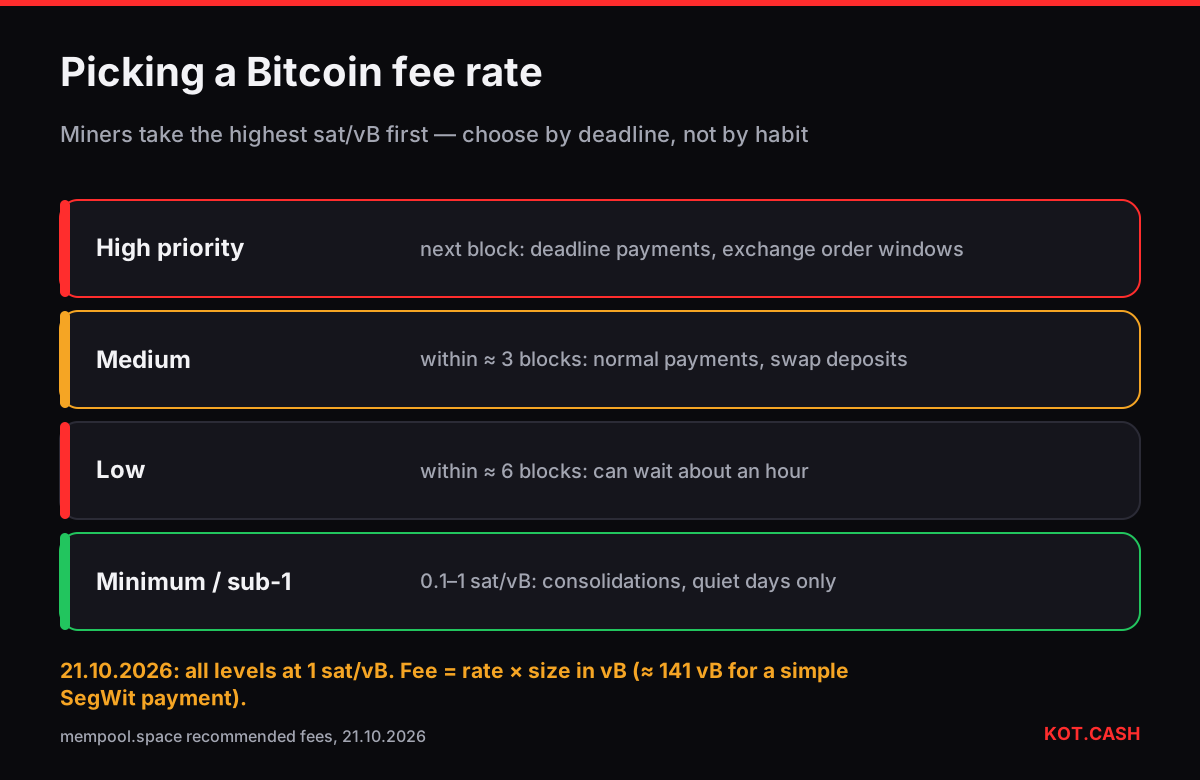
Choose a Bitcoin fee rate by looking at what is waiting in the mempool, not at what you paid last time. Miners fill each block with the transactions that pay the most satoshis per virtual byte (sat/vB), so the right rate is whatever puts you inside the next block or two at the moment you send. On 21 October 2026 mempool.space recommends 1 sat/vB for every priority level — a quiet mempool — while on busy days the same screen can say 20, 50 or more. Your total fee is that rate times the size of your transaction in vB.
What the mempool is
The mempool is each node's waiting room for valid transactions that are not yet in a block. There is no single global mempool; nodes keep their own, which is why explorers show slightly different numbers. A Bitcoin Core node keeps up to 300 MB of transactions by default and drops the lowest-paying ones when it is full. Transactions that stay unconfirmed for 14 days are also dropped by default — they do not vanish from your wallet, but nodes stop relaying them. The mempool guide explains this in more depth.
Reading the fee screen
Explorers such as mempool.space group waiting transactions into projected blocks. The first projected block shows the fee range miners would include if a block were found now; the next ones show what would follow. The recommended values are simply rates that land you in those projected blocks:
| Label | Aims for | Use when |
|---|---|---|
| High priority | Next block | Exchange deadline, time-sensitive payment |
| Medium priority | Within ≈ 3 blocks | Normal payment you want today |
| Low priority | Within ≈ 6 blocks | Not urgent, can wait an hour |
| No priority / minimum | Whenever space frees up | Consolidations, you can wait days |
When all levels show the same number, as they do today, the mempool clears every block and even the minimum gets confirmed quickly. When they differ widely, the gap tells you how much you pay for speed.
Below 1 sat/vB
For years 1 sat/vB was the floor: Bitcoin Core would not relay anything cheaper. Recent Bitcoin Core releases lowered the default minimum relay fee, and many nodes and miners now accept rates such as 0.1–0.5 sat/vB. On a quiet day you can see a large block of such transactions in the mempool histogram. They do confirm when blocks are not full, but not every wallet lets you set a fractional rate, and not every node relays them yet, so they can propagate slowly. For a payment to a service with a deadline, stay at 1 sat/vB or above.
Turning a rate into a fee
Bitcoin fees depend on transaction size, not on the amount sent. A typical payment from a native SegWit wallet with one input and two outputs (payment and change) is about 140 vB; with three inputs it is about 280 vB. Taproot inputs are slightly smaller, legacy inputs much larger.
| Shape | Size | At 1 sat/vB | At 20 sat/vB |
|---|---|---|---|
| 1 input → 2 outputs, SegWit | ≈ 141 vB | 141 sats ≈ $0.12 | 2,820 sats ≈ $2.33 |
| 3 inputs → 2 outputs, SegWit | ≈ 277 vB | 277 sats ≈ $0.23 | 5,540 sats ≈ $4.58 |
| 1 input → 2 outputs, legacy | ≈ 226 vB | 226 sats ≈ $0.19 | 4,520 sats ≈ $3.73 |
The Bitcoin transaction fee calculator computes the size for any number of inputs, outputs and address types.
A simple decision routine
- Open a mempool explorer and look at the first projected block's fee range.
- If your payment has a deadline — an exchange order window, an invoice — choose a rate at or slightly above the bottom of that range.
- If it can wait, choose the low-priority rate and check back in an hour. Fees are often lower at weekends.
- Make sure your wallet signals Replace-By-Fee (most do by default) so you can raise the fee later if the mempool fills up.
- If the transaction is stuck, bump it with RBF or have the recipient use CPFP. The RBF and CPFP calculator shows the exact fee needed.
Fee rate for a KOT.CASH deposit
A swap order shows a countdown for payment. The order counts your deposit once the transaction is seen and confirmed: the liquidity provider credits Bitcoin deposits after one confirmation. If you send at a very low rate during a busy period and the transaction does not confirm before the order expires, the swap can be delayed and support may need to step in. For deposits, use at least the medium-priority rate shown at the moment you send. On the payout side the Bitcoin network fee is included in the quote and you do not choose it.
FAQ
What is a good Bitcoin fee rate right now?
The rate that puts you in the first one or two projected blocks on a mempool explorer. On 21.10.2026 that is 1 sat/vB; on busy days it can be tens of sat/vB.
Can I pay less than 1 sat/vB?
Many nodes and miners now accept lower rates, and such transactions confirm in quiet periods. Propagation can be slower; avoid it for payments with deadlines.
Why does the fee not depend on the amount?
Block space is limited by bytes, so miners charge per virtual byte. Sending 0.001 BTC or 10 BTC costs the same if the transaction has the same shape.
What happens if my transaction stays in the mempool for two weeks?
Most nodes drop it after 14 days. The coins remain yours; you can rebroadcast or send a new transaction with a higher fee.
How many confirmations does KOT.CASH need for BTC?
The provider credits Bitcoin deposits after one confirmation.