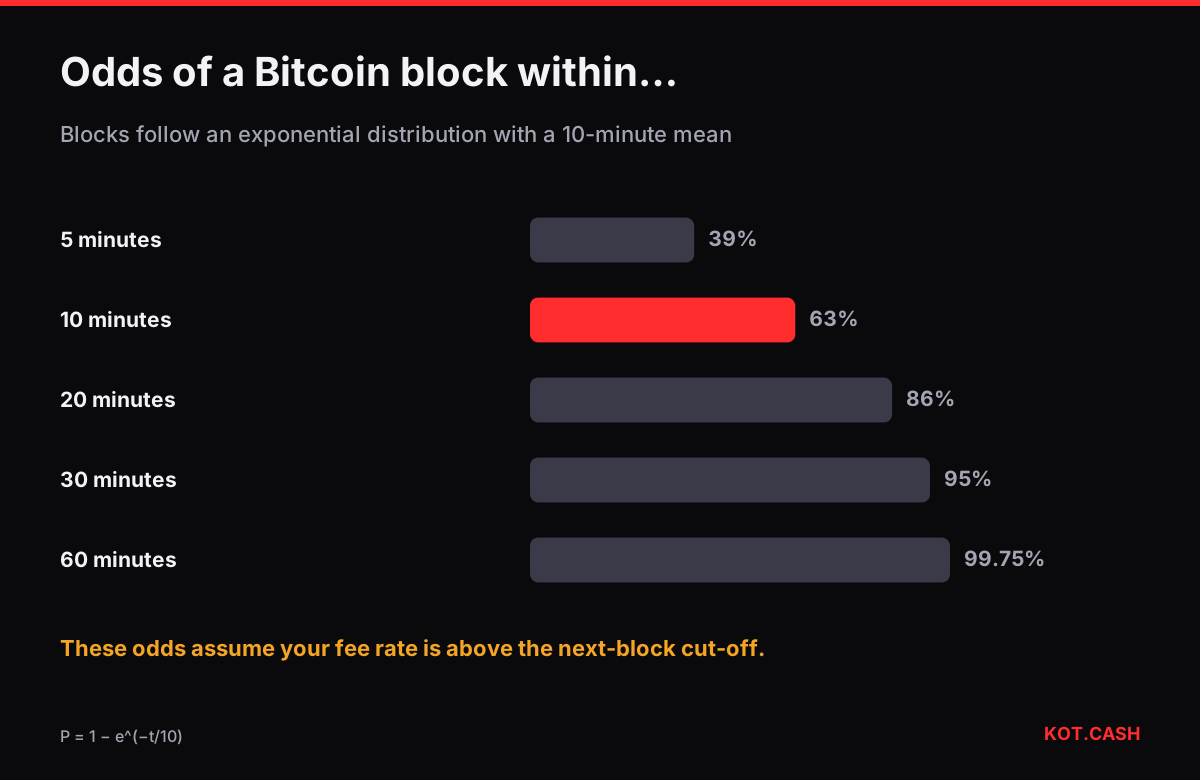
A Bitcoin transaction with a competitive fee usually gets its first confirmation within 10–20 minutes, because the network produces a block every ten minutes on average. That average hides a wide spread: the gap between two blocks is random, so 37% of the time you wait longer than ten minutes even if your fee is fine. If the fee rate is below what the mempool currently demands, the wait can stretch to hours or days. This page shows the real odds and the checks that tell you which case you are in.
Why ten minutes is only an average
Miners find blocks by trying random numbers until one produces a hash below the target. Each attempt is independent, so block discovery behaves like a Poisson process: the time to the next block follows an exponential distribution with a mean of ten minutes. Every 2,016 blocks, roughly two weeks, the difficulty adjusts to bring the average back to ten minutes if hashrate has changed.
For you that means: the probability that the next block arrives within t minutes is 1 − e^(−t/10). It does not matter how long ago the last block was found — the process has no memory.
| Wait | Probability | What it feels like |
|---|---|---|
| 5 minutes | 39% | lucky |
| 10 minutes | 63% | typical |
| 20 minutes | 86% | a bit slow |
| 30 minutes | 95% | slow, still normal |
| 60 minutes | 99.75% | rare — happens a few times a week |
Those odds apply only if your transaction makes it into the next block. Whether it does depends on the fee.
The fee rate decides which block you get into
A block has room for about 4 million weight units, roughly 1 MB of typical transactions. Miners fill it with the highest-paying transactions first, ranked by fee rate in satoshis per virtual byte (sat/vB), not by amount. A transaction paying 2 sat/vB when the next block's cut-off is 8 sat/vB will not be mined until demand drops.
Mempool explorers such as mempool.space show the current fee rate needed for the next block and for the blocks after it. Your wallet shows the rate you chose. Compare the two: if yours is above the next-block line, expect the timing in the table above; if it is well below, the wait is about demand, not luck. The Bitcoin fee calculator turns a fee rate into sats and dollars for your transaction size.
How many confirmations the recipient waits for
One confirmation means your transaction is in a block. Each further block on top makes reversing it harder. Recipients choose their own threshold. The liquidity provider behind KOT.CASH credits Bitcoin deposits after 1 confirmation; many exchanges use 1–3; some merchants and OTC desks wait for 6, about an hour on average. So 'how long' depends on who receives: count the confirmations they require and multiply by roughly ten minutes.
- 1 confirmation: on average 10 minutes after your transaction is picked up.
- 3 confirmations: on average 30 minutes, 95% of the time within about 63 minutes.
- 6 confirmations: on average 60 minutes, 95% of the time within about 1 hour 45 minutes.
You do not need a tool for this arithmetic, but the confirmation time estimator gives the median, 90% and 99% times for any number of confirmations if you want the full spread.
When to worry, and what to do
- Find the transaction by its ID in a block explorer. If it is not there at all, it was never broadcast; resend from the wallet.
- Check its fee rate against the current next-block rate. If it is close, wait. If it is far below, decide whether to bump.
- Bump the fee with Replace-By-Fee (RBF) if your wallet supports it — most do — or ask the recipient to spend it with a higher-fee child transaction (CPFP). The RBF and CPFP calculator works out the fee needed.
- Do not send again without bumping or cancelling: two transactions spending different coins means you pay twice.
- After about two weeks an unconfirmed transaction is dropped from most nodes' mempools (Bitcoin Core's default expiry is 336 hours), and the coins show as spendable again in your wallet.
Timing inside a swap
In a BTC swap the Bitcoin leg is usually the longest part. Sending BTC to a BTC to USDT order means waiting for your deposit's one confirmation; buying BTC with USDT means waiting for the payout's first block in your wallet. Both directions typically take 10–30 minutes end to end, almost all of it Bitcoin block time.
FAQ
How long does a Bitcoin transaction take on average?
About 10 minutes to the first confirmation if the fee is competitive, because blocks arrive every 10 minutes on average.
Why is my Bitcoin transaction unconfirmed for hours?
Its fee rate is below what miners currently include. Compare it with the next-block rate in a mempool explorer and bump it with RBF or CPFP if needed.
How long do 6 confirmations take?
About an hour on average, and within about 1 hour 45 minutes in 95% of cases.
Can a Bitcoin transaction be faster than 10 minutes?
Yes. 39% of the time the next block comes within 5 minutes.
What happens if a transaction never confirms?
Nodes drop it after about two weeks by default, and the coins become spendable again in your wallet.