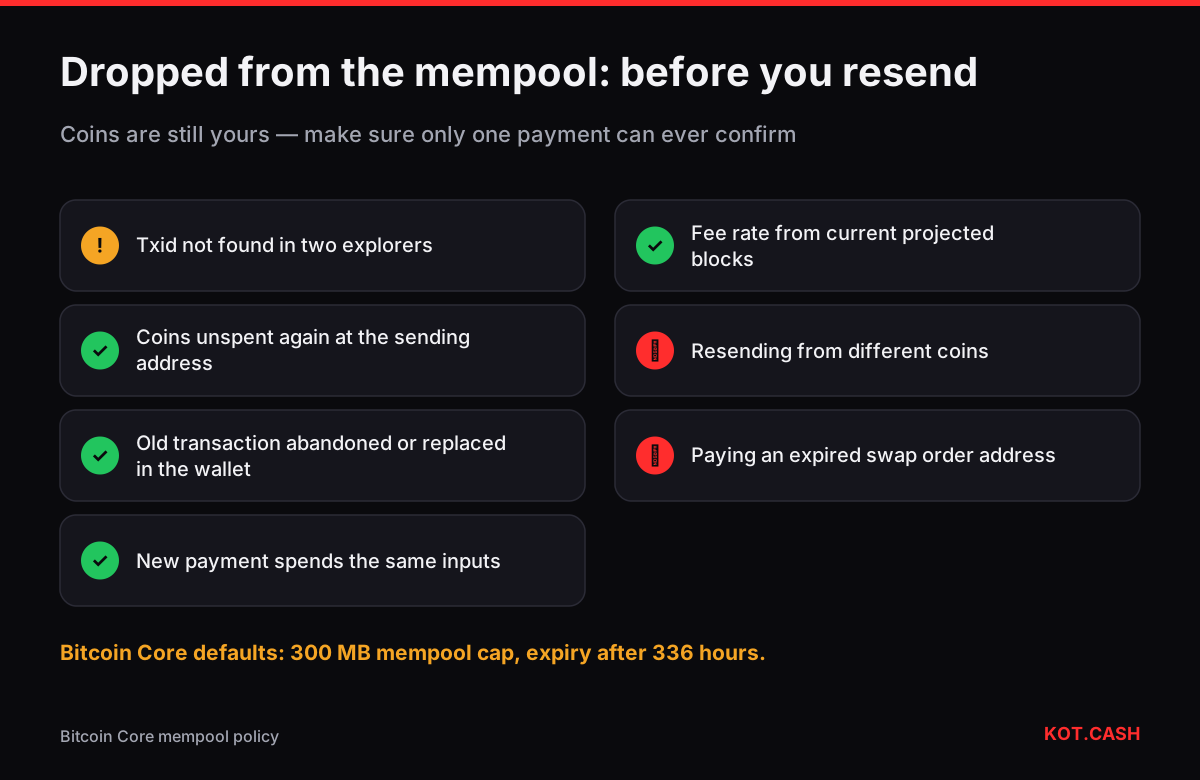
If an unconfirmed Bitcoin transaction disappears from explorers, it has been dropped from node mempools — usually because its fee rate was too low for too long. A dropped transaction never happened as far as the blockchain is concerned: your coins are still at the original address, spendable by your wallet. You can send them again with a proper fee, but do it in a way that replaces the old transaction rather than racing it.
If the transaction is still visible and just slow, you do not need this guide yet — bump the fee instead. The RBF and CPFP fee bump calculator works out the fee for both methods.
Why nodes drop transactions
Every Bitcoin node keeps its own mempool of unconfirmed transactions, with limits. In Bitcoin Core the defaults are a 300 MB memory cap and an expiry of 336 hours (two weeks). When the mempool is full, the node evicts the lowest fee-rate transactions and raises its minimum fee, so new low-fee transactions are not accepted at all. A transaction that sits below the market rate for two weeks is removed when it expires. Nodes do not coordinate this: one explorer may still show the transaction while another has forgotten it.
Checklist before you resend
- Search the txid in two explorers (for example mempool.space and Blockchair). Not found in either — it is dropped from the nodes they use.
- Check the address balance. The input coins should appear as unspent again at the sending address.
- Look at your wallet. Many wallets still show the transaction as pending because they keep their own copy and may rebroadcast it.
- Ask the recipient whether they still see it. A merchant or exchange node might hold it and rebroadcast later.
- Note whether RBF was enabled. If it was, a replacement is straightforward.
How to resend safely
The danger in resending is not losing money but paying twice: if you create a new transaction that spends different coins while the old one can still be rebroadcast and confirmed, both could confirm. The safe approach is to spend the same inputs again, so only one of the two can ever be valid.
- In the wallet, remove or abandon the old transaction. Bitcoin Core has
abandontransactionfor dropped transactions; Electrum lets you remove a local, unbroadcast or unconfirmed one from history; Sparrow lets you cancel or replace it. - Create the new payment so it uses the same inputs (coin control in Sparrow or Electrum makes this explicit), with a fee rate taken from current projected blocks.
- If RBF was signalled on the original, simply use the wallet's Bump fee or Replace function — that guarantees the same inputs.
- Broadcast and watch the new txid. Once it has one confirmation, the old transaction is permanently invalid.
Why this happens more often than it used to
Fee markets on Bitcoin swing fast. A rate that was enough on a quiet Sunday can sit far below the market after a busy Monday morning, and wallets that let you pick 'economy' or set a custom rate make it easy to choose too low. Exchanges batch withdrawals at moderate rates, while ordinals and other inscriptions can fill blocks for days. A transaction broadcast at the bottom of the range then waits behind everything else, and if the backlog does not clear within the expiry window, it is removed. Picking a rate that targets the next few blocks rather than 'within a day' costs a little more and avoids this whole procedure.
Choosing a fee that will not get dropped again
The cause of the drop was a fee rate below what the mempool required. Look at the current projected blocks on an explorer and pick a rate that would place the transaction within the next few blocks, not the minimum shown. Transaction size depends on inputs and address types; the Bitcoin transaction fee calculator converts your inputs and outputs into vbytes and a fee in sats.
If the payment was going to a swap
A KOT.CASH order that was paid with a transaction that later dropped never received the BTC, and an unpaid order expires when its countdown ends. Do not resend to an expired order's address; create a new order and pay it with a fresh transaction that spends the same coins as the dropped one. If the original transaction reappears and confirms after you have paid a new order, contact support with both txids.
FAQ
Are my bitcoins lost if the transaction was dropped?
No. A dropped transaction was never confirmed, so the coins remain at your address and your wallet can spend them again.
How long does Bitcoin keep an unconfirmed transaction?
Bitcoin Core nodes drop it after 336 hours (two weeks) by default, or sooner if the mempool fills up and its fee rate is among the lowest.
Why does my wallet still show it as pending?
Wallets keep their own record and may keep rebroadcasting. Abandon or replace it in the wallet before resending.
Can the old transaction come back?
Yes, if any node still has it and rebroadcasts it, and only if its inputs are still unspent. Spending the same inputs in a new transaction prevents that.
Is a dropped transaction the same as a failed one?
Bitcoin transactions do not fail after broadcast; they either confirm, stay pending, get replaced or get dropped. A dropped one costs no fee.