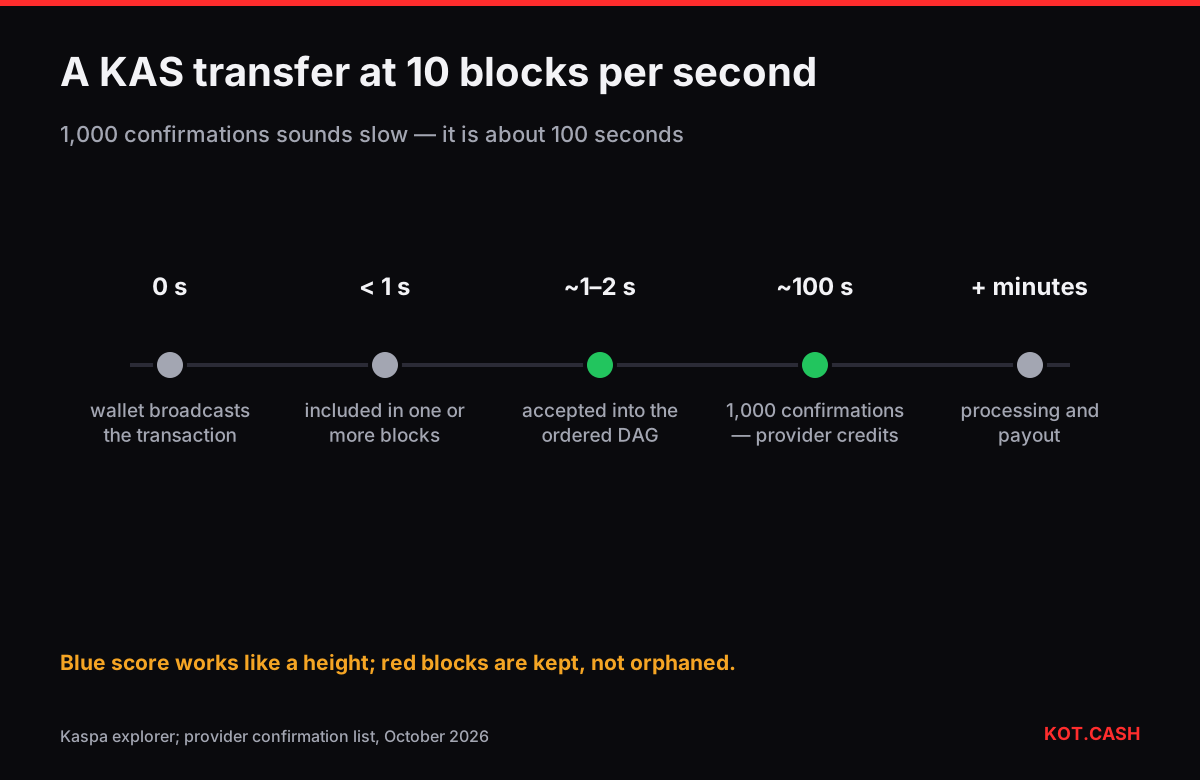
To check a Kaspa transfer, paste its transaction ID (64 hex characters) or your kaspa:q… address into the official explorer at explorer.kaspa.org, or into an alternative such as kas.fyi. The transaction page shows whether it was accepted by the network, the block it was first included in, and a growing confirmation count. Kaspa is unusual in two ways that change how you read those numbers: blocks are produced ten times per second, and they form a DAG rather than a single chain.
From send to credited: the timeline
Since the Crescendo hard fork in May 2025, Kaspa runs at 10 blocks per second. A transaction is typically included within a second of being sent and accepted shortly after, once the blocks that contain it are merged by the DAG's ordering rules. Confirmations then count up very quickly. The KOT.CASH liquidity provider waits for 1,000 confirmations on KAS deposits — a number that sounds huge but corresponds to roughly 100 seconds of blocks. In practice processing on the provider side adds a few minutes on top.
Blocks in a DAG: blue, red and accepted
On Bitcoin, two miners who find a block at the same time produce an orphan: one block wins, the other is discarded. Kaspa's GHOSTDAG protocol keeps both. Each block references several parents, and the protocol colours blocks blue (well connected, part of the main ordering) or red (late or poorly connected). Red blocks are not thrown away; their transactions can still be accepted if they do not conflict. The explorer shows a block's colour and its blue score, the count of blue blocks in its past, which works like a height. A transaction's confirmations are the blue score difference between the current tip and the block that accepted it.
- Accepted: yes — the transaction is in the DAG's ordered history. This is the status to look for.
- Block hash / including block — where it first appeared; there may be more than one including block.
- Confirmations — grows by about ten per second.
- Inputs and outputs — Kaspa uses a UTXO model like Bitcoin, so you see the coins spent and created, including change.
- Fee — usually a tiny fraction of a KAS.
Addresses and common mistakes
Kaspa addresses start with kaspa: followed by q (Schnorr key), p (script) or, for ECDSA keys, a different type letter. Some wallets and exchanges show the address without the prefix; it is still the same address. Mistakes we see most often are pasting a Kaspa address into an exchange form for another coin (rejected by the format check), sending from an exchange that does not support the current network version, and expecting a deposit to be credited instantly — the provider's confirmation count and processing still apply.
Explorer options
| Explorer | Strengths |
|---|---|
| explorer.kaspa.org | Official, simple transaction and address pages |
| kas.fyi | Charts, rich address history, token (KRC-20) views |
| Wallet built-in links | Kaspium, KasWare and Kaspa NG link straight to a transaction |
Checking a KAS payment to or from a swap
- Open the transaction ID from your wallet in the explorer.
- Confirm Accepted and that one output pays the deposit address from the order page the full amount.
- Watch the confirmation count pass 1,000 — under two minutes — then allow a few minutes for processing.
- For a payout in KAS, open the payout transaction ID from the order page and find the output to your address.
Kaspa's minimum swap amounts are relatively high because the coin's price is low — the provider minimum for KAS to USDT was around 800 KAS in October 2026. Guides for buying Kaspa with USDC and selling Kaspa for USDT cover the exact flow. The confirmation time estimator compares how long 1,000 Kaspa confirmations take against confirmations on other networks.
FAQ
Why does a Kaspa deposit need 1,000 confirmations?
Kaspa produces 10 blocks per second, so 1,000 confirmations take only about 100 seconds — similar security time to a few blocks elsewhere.
What does 'accepted' mean on the Kaspa explorer?
The transaction is part of the DAG's ordered history. Look for Accepted before counting confirmations.
Are red blocks bad for my transaction?
No. Red blocks stay in the DAG; their transactions can still be accepted if there is no conflict.
What is the blue score?
The number of blue blocks in a block's past. It works like a block height for counting confirmations.
Why can't I send a very small amount of KAS?
The storage mass rule makes creating tiny outputs expensive, so wallets limit dust transfers.