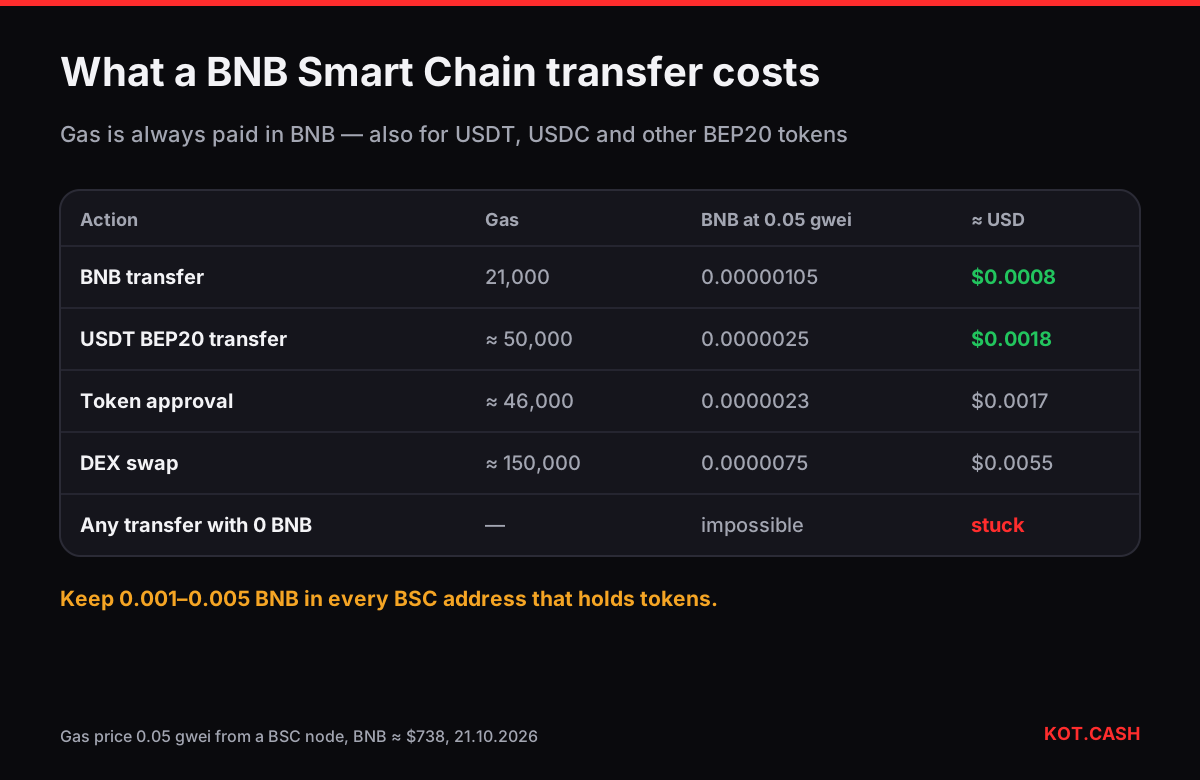
A transfer on BNB Smart Chain (BSC) costs a fraction of a cent to a few cents, and it is always paid in BNB — including when you send USDT, USDC or any other BEP20 token. BSC is an EVM chain, so the fee is calculated exactly as on Ethereum: gas used × gas price. The difference is the price: BSC gas is quoted in fractions of a gwei of BNB, and blocks arrive in well under a second, so there is little competition for space. The one thing that regularly costs people money on BSC is not the fee itself but having no BNB at all when they need to move a token.
How the fee is calculated
Gas usage on BSC matches Ethereum because the virtual machine is the same: 21,000 gas for a native BNB transfer, roughly 45,000–65,000 for a BEP20 token transfer, more for swaps on PancakeSwap or other DEXs. The gas price is set by the network's validators. Validators lowered the minimum several times during 2025; on 21 October 2026 BSC nodes report a gas price of 0.05 gwei, and wallets usually suggest a value close to that because blocks are rarely full.
| Action | Gas | BNB | ≈ USD |
|---|---|---|---|
| BNB transfer | 21,000 | 0.00000105 | $0.0008 |
| USDT BEP20 transfer | ≈ 50,000 | 0.0000025 | $0.0018 |
| Token approval | ≈ 46,000 | 0.0000023 | $0.0017 |
| DEX swap | ≈ 150,000 | 0.0000075 | $0.0055 |
Even at ten times that gas price a token transfer stays around two cents. If a wallet proposes something dramatically higher, it is usually an outdated default or the max-fee field shown as the price. Compare with BscScan's gas tracker before confirming.
Why you always need some BNB
On BSC only BNB pays for gas. A wallet holding 500 USDT BEP20 and zero BNB cannot send that USDT anywhere — not to an exchange, not to a swap, not to your own other wallet. This situation comes up constantly: someone withdraws USDT from an exchange on the BEP20 network to a fresh wallet and then discovers the wallet cannot move it.
- Keep at least 0.001–0.005 BNB in every BSC address that holds tokens. That covers dozens of transfers at today's prices.
- If you swap away all your BNB, check first that no tokens remain in the wallet.
- If you are stuck with tokens and no BNB, withdraw a small amount of BNB on the BSC network from an exchange, or ask someone to send you a little. Some wallets offer a built-in gas top-up; check what it costs.
- On KOT.CASH you can also swap a small amount of another coin into BNB on BSC and receive it straight to the stuck address.
BSC, BEP20, opBNB: the names on withdrawal screens
Exchanges label this network as BSC, BEP20 or “BNB Smart Chain”; all three mean the same chain with 0x addresses. Two names mean something else. BEP2 was the token standard of the BNB Beacon Chain, which was shut down in 2024; addresses started with bnb1 and used memos. opBNB is a separate layer-2 network on top of BSC with the same address format. Funds sent on opBNB to a BSC deposit address do not arrive on BSC. The opBNB vs BNB Smart Chain guide explains the difference.
Your 0x address is the same on BSC, Ethereum, Polygon and other EVM networks because it is derived from the same key. That is convenient and dangerous at once: a withdrawal on the wrong network lands at an address you control, but on a chain where the receiving service may not be watching.
Speed and confirmations
BSC blocks follow each other in under a second after the 2025 upgrades, so a transfer is usually in a block almost immediately. Receiving services wait for a number of blocks before crediting: the swap provider used by KOT.CASH waits for 60 BSC blocks, which takes about a minute. If a BSC transaction does not appear on BscScan at all, it was not broadcast; if it appears as pending for a long time, the gas price was set below what validators accept.
Fee on a swap through KOT.CASH
When you send BNB or a BEP20 token to a swap deposit, you pay the BSC gas for that transfer from your wallet, as usual. When you receive BNB or a BEP20 token as a payout, the payout's network fee is already deducted in the quote — you do not need BNB in the receiving wallet to get the payout. You will need BNB later to move tokens onward. Current minimums are on the BNB to USDT page.
FAQ
How much BNB do I need to send USDT BEP20?
A few millionths of a BNB per transfer at current gas prices (about 0.0000025 BNB for a USDT transfer). Keeping 0.001–0.005 BNB gives you plenty of transfers.
Can I pay BSC gas in USDT?
Not natively. The network charges gas only in BNB. Some wallets offer paid gas top-ups as a separate service.
Is BEP20 the same as BSC?
Yes, BEP20 is the token standard on BNB Smart Chain. BEP2 was a different, now retired chain.
Why is my BSC transaction pending?
Usually the gas price was set below the validators' minimum or the wallet's node did not broadcast it. Check the hash on BscScan and resend with a normal gas price.
Do I need BNB to receive tokens?
No. Receiving costs you nothing; the sender pays the gas. You need BNB only to send them on.