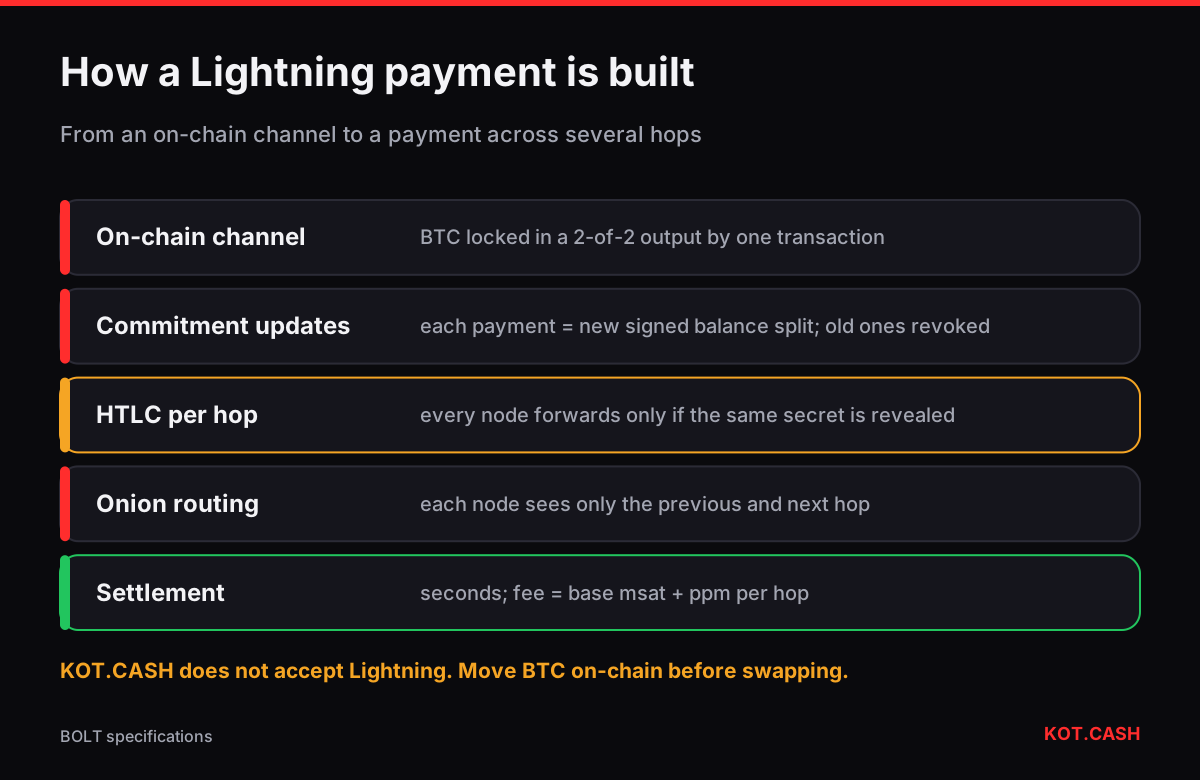
The Lightning Network is a payment layer on top of Bitcoin. Instead of putting every payment into a block, two parties lock bitcoin in a shared on-chain output (a channel) and then update who owns what by exchanging signed transactions between themselves. Payments can hop across several channels to reach anyone on the network, settle in seconds and cost a few satoshis. The trade-off: you need a Lightning wallet, channels need liquidity, and an ordinary on-chain service — including the KOT.CASH swap, which does not support Lightning — cannot receive a Lightning payment.
The three building blocks
- Channels. Opening a channel is one on-chain transaction that locks BTC in a 2-of-2 output controlled by both peers. Closing it is another on-chain transaction that pays each side its latest balance.
- Commitment transactions. Every payment inside a channel replaces the previous balance split with a new pair of signed transactions. Old states are revoked: if one side broadcasts an outdated state, the other can claim the whole channel as a penalty.
- HTLCs and routing. To pay someone you have no channel with, the payment travels through intermediate nodes. Hash time-locked contracts make each hop conditional on revealing the same secret, so either the whole route completes or nothing moves.
Routes are found by the sender's wallet, and the payment itself is wrapped in onion encryption: each node learns only the previous and next hop, not the full path or the final recipient.
Units and fees
Lightning counts in millisatoshis (msat), thousandths of a satoshi, because routing fees on small payments are smaller than one satoshi. Each channel's owner sets two numbers: a base fee (often 0–1,000 msat) and a proportional fee in parts per million (ppm). A node charging 1 sat base plus 100 ppm takes 1 + 0.0001 × amount for forwarding. A payment of 100,000 sats through three such hops costs about 33 sats in routing fees — around $0.03 at BTC near $82,600. The Lightning routing fee calculator adds up any route and compares it with an on-chain fee.
| Lightning | On-chain | |
|---|---|---|
| Time to settle | seconds | ~10 min for 1 confirmation, varies |
| Fee | a few sats in routing fees | vsize × sat/vB, often hundreds to thousands of sats |
| What the receiver needs | a Lightning wallet with inbound liquidity | any Bitcoin address |
| Visibility | not recorded on the blockchain per payment | public transaction in a block |
| Accepted by swap services and exchanges | some exchanges; not KOT.CASH | everywhere |
Custodial and self-custodial wallets
Self-custodial Lightning wallets such as Phoenix, Breez, Zeus or a node running LND or Core Lightning hold your keys and manage channels for you; some open a channel automatically with their service provider (an LSP) when you first receive. Custodial wallets keep balances on their own node and show you an account — simpler, but the provider holds your bitcoin, as an exchange would. Exchanges that support Lightning deposits and withdrawals are effectively custodial Lightning wallets with a trading desk attached.
Limits worth knowing
- Liquidity. You can only send what you have on your side of your channels and only receive up to your inbound capacity. See channel liquidity explained.
- Online requirement. A self-custodial receiver must be online, or use a service that wakes the wallet, to accept a payment.
- Large payments. Payments of several million sats can fail for lack of a route with enough capacity; multi-path payments split them, but not always successfully.
- Channel reserves and on-chain costs. Opening and closing channels pays on-chain fees, which matter when mempool fees are high.
- Backups. Channel state cannot be restored from the seed phrase alone in every wallet; follow the wallet's backup instructions.
One more limit is economic rather than technical: an on-chain transaction is needed to enter and leave Lightning. If you only make one payment, the channel open and close may cost more than paying on-chain once. Lightning pays off when you make many small payments from the same channel.
Lightning and KOT.CASH
KOT.CASH swaps use on-chain Bitcoin only. The deposit for a BTC → USDT or BTC → ETH swap is a normal Bitcoin address, and payouts in BTC go to an on-chain address. If your bitcoin is on Lightning, move it on-chain first — through your wallet's swap-out or a submarine swap service — and then swap. The steps are in move bitcoin from Lightning to on-chain. Pasting a Lightning invoice where an on-chain address is expected does not work; the invoice vs address guide shows how to tell them apart.
FAQ
Is Lightning a separate cryptocurrency?
No. Lightning moves real bitcoin locked in on-chain channels; there is no separate coin.
How much does a Lightning payment cost?
Usually a few satoshis: each hop charges a base fee plus a small proportional fee in parts per million.
Can I send Lightning BTC to KOT.CASH?
No. KOT.CASH accepts on-chain BTC only. Move Lightning funds on-chain first.
Do I need to run a node to use Lightning?
No. Mobile wallets manage channels for you, and custodial wallets need no setup at all, at the cost of trusting the provider.
Are Lightning payments private?
They are not recorded on-chain individually and are onion-routed, but channel opens and closes are public, and custodial providers see your payments.