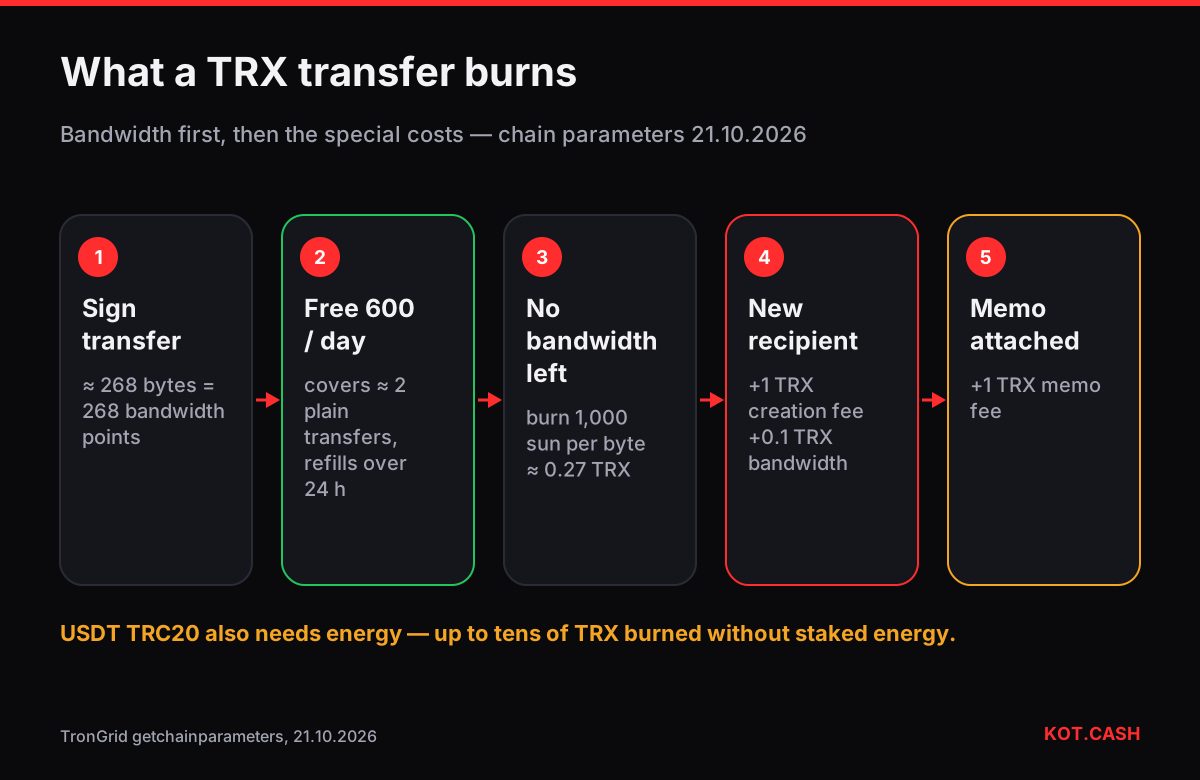
TRON has two resources instead of a single fee: energy, used by smart contracts such as USDT, and bandwidth, used by every transaction for its size in bytes. Each account receives 600 bandwidth points for free every day, enough for two or three plain TRX transfers. When an account has no bandwidth left, the network burns TRX instead, at 1,000 sun (0.001 TRX) per byte. Sending TRX to an address that has never been used costs more again — about 1.1 TRX — because the transfer also creates the account. This guide covers bandwidth and activation; USDT's energy cost is explained in the TRC20 fee guide.
Bandwidth in numbers
Bandwidth is measured in points, one point per byte of the signed transaction. A simple TRX transfer is around 265–270 bytes; a USDT transfer, which carries contract call data, is around 345 bytes. These numbers are read from the chain parameters, not estimated: on 21 October 2026 TronGrid reports getFreeNetLimit = 600 and getTransactionFee = 1,000 sun per byte.
| Transaction | Size, bytes | Covered by free 600? | TRX burned if not |
|---|---|---|---|
| TRX transfer | ≈ 268 | Yes, ≈ 2 per day | ≈ 0.268 TRX |
| USDT TRC20 transfer | ≈ 345 | Bandwidth yes; energy no | ≈ 0.345 TRX + energy |
| TRX transfer with memo | ≈ 300 | Bandwidth yes | + 1 TRX memo fee |
| TRX to a new address | ≈ 268 | No — special rule | 0.1 TRX + 1 TRX creation |
Free bandwidth regenerates gradually over 24 hours rather than resetting at midnight. If you send many transactions from one address, the first couple are free and the rest burn TRX at the byte rate. Staking TRX for bandwidth gives an address its own allowance on top of the free points.
Account activation: the 1.1 TRX surprise
A TRON address does not exist on chain until it receives its first TRX or TRC10 transfer. Creating it is charged to the sender, and the free daily bandwidth does not cover it:
- Account creation fee in the system contract: 1 TRX (getCreateNewAccountFeeInSystemContract = 1,000,000 sun).
- Bandwidth for creating the account: 0.1 TRX burned (getCreateAccountFee = 100,000 sun), unless the sender has bandwidth from staked TRX.
So the first TRX transfer to a fresh address usually costs the sender about 1.1 TRX on top of the amount sent, roughly 36 cents at $0.33 per TRX. Every later transfer to the same address costs only bandwidth. Exchanges include this in their withdrawal fee, which is one reason TRX withdrawal fees vary.
USDT works differently: sending USDT to an address that has never held USDT does not activate the TRON account in the same way, but it costs much more energy, because the contract has to create the recipient's balance slot. The USDT TRC20 fee calculator shows that difference with the current energy price.
The memo fee
TRON lets you attach a note (memo) to a TRX transfer. Since a governance proposal adopted by TRON validators, adding a memo burns 1 TRX on top of bandwidth; the current parameter getMemoFee is 1,000,000 sun. Some exchanges ask for a memo on TRX deposits to shared addresses — check the deposit page. KOT.CASH does not need a memo for TRX or USDT TRC20 deposits; the deposit address alone identifies your order.
How to avoid paying more than necessary
- Receive TRX first, before tokens: an activated account with a TRX balance can pay its own bandwidth when it sends.
- Space out small transfers from the same address so the free 600 points regenerate.
- If you send many TRON transactions every day, stake TRX for bandwidth (and energy for USDT) instead of burning TRX each time.
- Do not add a memo unless the receiver requires one.
- Keep a TRX reserve of at least 5–30 TRX in a wallet that sends USDT, depending on how often you send.
What you see in Tronscan
Open any transaction on Tronscan and look at the resources block. “Bandwidth consumed” shows the bytes; if the free allowance covered them, the TRX burned for bandwidth is zero. For a first transfer to a new account you will see the creation fee listed separately. For USDT you will additionally see energy consumed and, if no energy was staked or rented, the TRX burned for it at 100 sun per energy unit (getEnergyFee). The Tronscan guide walks through each field.
TRX for swaps on KOT.CASH
If you need TRX to pay for USDT transfers, you can swap a small amount of another coin into TRX on KOT.CASH and receive it directly to your TRON address. When the receiving address is new, the activation cost is part of the payout and already reflected in the quote, so you do not pay it separately. Deposits on TRON are credited after 20 confirmations, about a minute with three-second blocks. Pages: TRX to USDT and TRX to BTC.
FAQ
How much free bandwidth does a TRON account get?
600 points per day at the time of writing (chain parameter getFreeNetLimit). A TRX transfer uses about 268.
Why did sending TRX to a new address cost 1.1 TRX?
The transfer created the account: 1 TRX creation fee plus 0.1 TRX bandwidth for the creation, paid by the sender.
Does a memo on TRON cost extra?
Yes. A memo burns an additional 1 TRX (getMemoFee). Add one only if the recipient requires it.
Is bandwidth the same as energy?
No. Bandwidth pays for transaction size; energy pays for smart-contract execution such as USDT transfers.
How many confirmations does a TRON deposit need on KOT.CASH?
20 blocks, about a minute.