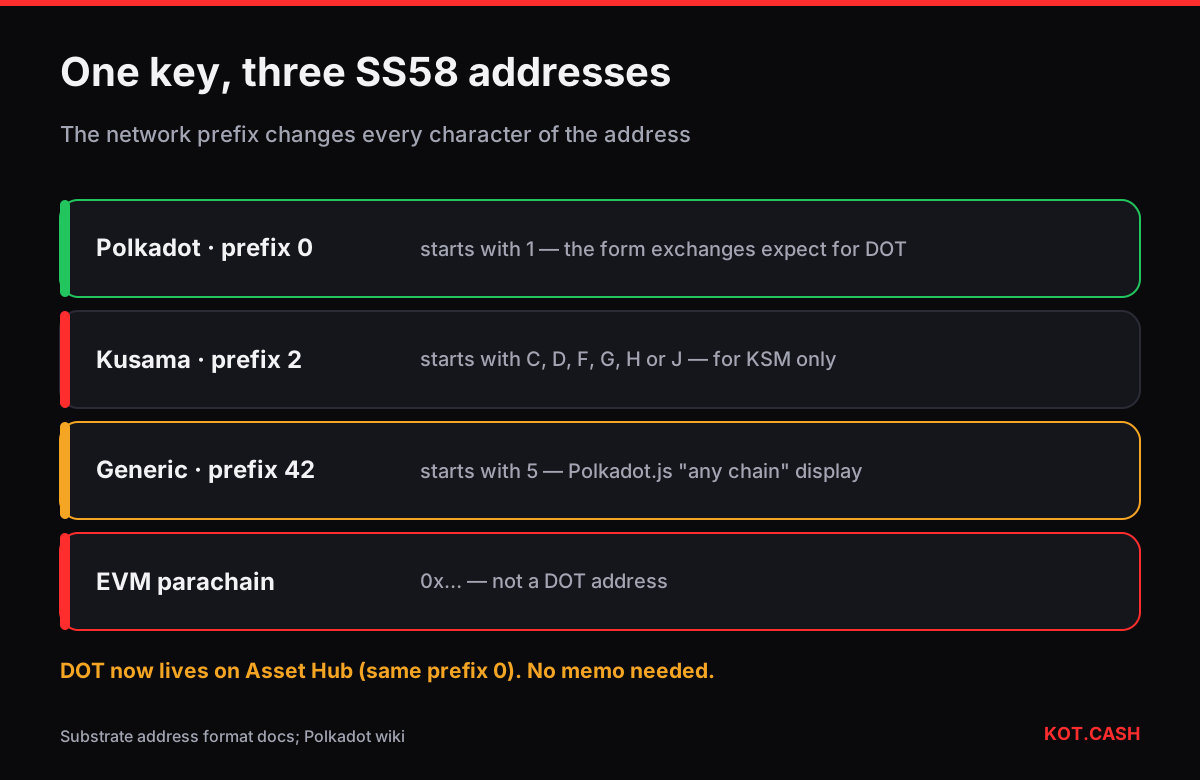
A Polkadot address for DOT starts with 1 and is 47–48 characters long. If your wallet shows an address starting with 5, it is the same account written in the generic Substrate format; if it starts with a capital letter such as C, D, F, G, H or J, it is the Kusama format. All three are encodings of one public key with a different network prefix — SS58 — and exchanges and swap services expect the Polkadot form starting with 1 for DOT.
How SS58 works
An SS58 address is Base58 of three parts: a network prefix, your 32-byte public key and a two-byte checksum computed with BLAKE2b over both. Change the prefix and every character of the Base58 string changes, even though the key is the same. That is why the same Polkadot.js account can look completely different on Polkadot, Kusama or a parachain. The checksum also protects against typos: a mistyped address fails validation. DOT itself has 10 decimal places; the smallest unit is called a planck.
| Network | SS58 prefix | Address starts with | Used for |
|---|---|---|---|
| Polkadot (relay and Asset Hub) | 0 | 1 | DOT, USDT/USDC on Asset Hub |
| Kusama | 2 | C, D, F, G, H, J | KSM |
| Generic Substrate | 42 | 5 | display in Polkadot.js, test networks |
| Many parachains | own prefix | varies | the parachain's own tokens |
Why Polkadot.js shows a 5… address
The Polkadot{.js} browser extension stores keys without a network. If an account is set to "allow use on any chain", the extension displays it in the generic format with prefix 42, which starts with 5. Talisman, SubWallet and Nova Wallet usually show the address per network, so you see 1… on Polkadot. Both point to the same key, but some exchange forms reject a 5… address for DOT withdrawals because they validate the prefix. Switch the account to the Polkadot network in the extension, or copy the address from the Polkadot row in your wallet, to get the 1… form.
- Open your wallet and select the account.
- Choose the Polkadot network (or Polkadot Asset Hub) for that account.
- Copy the address that starts with 1.
- If you only have a 5… address, an explorer such as Subscan converts formats — paste the address and choose the Polkadot prefix — and you can check that the public key in both forms is identical.
Polkadot, Asset Hub and the swap network
Polkadot has moved everyday DOT balances from the relay chain to Asset Hub, a system parachain that also holds tokens such as USDT and USDC on Polkadot. Asset Hub uses the same SS58 prefix 0, so your DOT address looks the same. The liquidity provider lists DOT under the network code STATEMINT, which is Asset Hub's technical name, and waits for 15 confirmations on deposits. Choose DOT on Asset Hub when your wallet asks which chain to send from, and check that the receiving service lists the same network.
The existential deposit
Substrate chains delete accounts whose balance drops below the existential deposit (ED); the dust left is lost. Wallets warn you before a transfer would leave an account below the ED, and many offer "keep alive" transfers that refuse to drop below it. The ED differs between the relay chain and Asset Hub; your wallet shows the current value. When you send all DOT to a swap order, either send the full balance on purpose (the account is reaped, which is fine if you do not need it) or leave more than the ED behind.
Staked and locked DOT
DOT used for staking or nomination pools is locked and cannot be sent. Unbonding takes 28 days on Polkadot, during which the DOT earns nothing; Kusama uses 7 days. Plan any swap around that — the unbonding period lookup lists periods for other networks. Locked governance votes can also hold DOT for a conviction period.
Checking an address before sending
- The first character tells the network: 1 = Polkadot, capital letters = Kusama, 5 = generic. A 0x… string is an EVM address (for example on Moonbeam) and not a DOT address.
- Length is 47–48 characters for Polkadot addresses.
- The address validator and Subscan check the checksum.
- If the recipient is an exchange, use exactly the format and network it shows; do not convert its address yourself.
Swapping DOT
For DOT to USDT the DOT to USDT page gives you a 1… deposit address on Asset Hub. For a DOT payout, paste your 1… address; the provider's list of confirmations is on the deposit confirmations page.
FAQ
Why does my DOT address start with 5?
Your wallet shows the generic Substrate format. It is the same key; switch to the Polkadot network to get the 1… form that exchanges expect.
Is my Kusama address the same account as my Polkadot address?
It can be the same key, but the encoding and the network differ. KSM must go to the Kusama-format address on Kusama.
Do I need a memo to send DOT to an exchange?
Usually not. Polkadot deposits are identified by address. Follow the exchange's instructions if it shows anything else.
What is the existential deposit?
The minimum balance an account needs to exist. Below it the account is removed and the remaining dust is lost.
How long does unstaking DOT take?
28 days on Polkadot. During unbonding the DOT earns nothing and cannot be transferred.