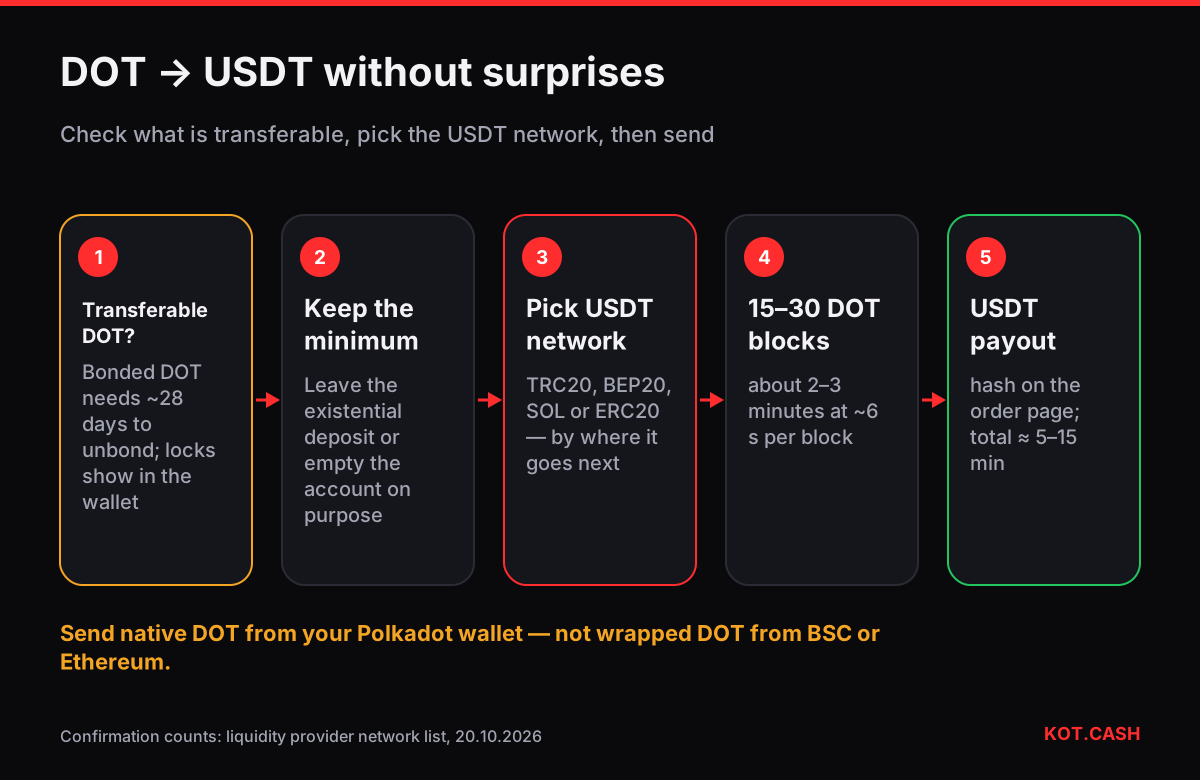
To swap DOT to USDT, send native DOT from Nova, Talisman, SubWallet, Polkadot.js or a Ledger to a swap order and receive USDT on the network you pick — TRON, Ethereum, BNB Smart Chain or Solana. On KOT.CASH that is the DOT to USDT page; the widget shows the USDT amount up front and a standard swap needs no account. Polkadot has two quirks that catch people out — the existential deposit and unbonding — and the USDT network choice decides how cheap the next transfer will be.
Where your DOT lives now: Asset Hub
Polkadot moved account balances and everyday transfers from the relay chain to its Asset Hub system chain. Modern wallets handle this for you and still show the balance as Polkadot DOT; the liquidity provider's network list also uses Asset Hub for DOT deposits. In practice you send DOT the way your wallet suggests for a normal Polkadot transfer. If you use an old wallet or an exchange that still shows a choice of "Relay chain" and "Asset Hub", choose the one the order page refers to.
Addresses use the SS58 format and start with 1 on Polkadot. The same key gives addresses with different prefixes on parachains; copy the Polkadot one.
Existential deposit and staking
- Existential deposit. A Polkadot account must keep a minimum balance. If a transfer would leave less, the wallet either refuses or warns that the account will be reaped and the dust lost. Send slightly less than the full balance, or empty the account on purpose.
- Staked or pooled DOT. Bonded DOT has to be unbonded first, and unbonding takes about 28 days on Polkadot. Your wallet shows the exact date the funds become transferable.
- Vesting or locked DOT. Governance votes with conviction and vesting schedules lock balances. The wallet shows what is transferable now.
- Wrapped DOT. BEP20 or ERC20 "DOT" tokens are separate assets on other chains; this pair takes native DOT.
Which USDT network to receive on
Pick the network by where the USDT goes next, not by habit.
| Network | Address | Later transfer cost | Good for |
|---|---|---|---|
| TRC20 (TRON) | T… | several TRX of energy per transfer | exchanges and P2P desks that expect TRON |
| BEP20 (BSC) | 0x… | a few cents in BNB | wallets that already hold BNB |
| SOL (Solana) | base58 | fractions of a cent in SOL | Phantom/Solflare users, frequent transfers |
| ERC20 (Ethereum) | 0x… | highest, paid in ETH | Ethereum DeFi, hardware-wallet storage |
Whichever you choose, the wallet will need that chain's native coin to move the USDT later: TRX on TRON, BNB on BSC, SOL on Solana, ETH on Ethereum. The USDT TRC20 fee calculator shows the TRON cost; the stablecoin fee comparison compares all four.
What 100 DOT is worth in USDT
DOT has traded in a wide range over the years, so check the live table on the pair page or the crypto converter before you decide. At about $1.14 per DOT, 100 DOT is roughly $114, or about 113 USDT after a 1% fee. The arithmetic is simple: amount × DOT price, minus 1% on the float rate (1.5% fixed) and the payout network fee. The widget quote already includes both, so the number it shows is what arrives.
Step by step and timing
- Open DOT to USDT, enter the amount and pick the USDT network.
- Paste a USDT address for exactly that network. A TRON address on an ERC20 order, or the other way round, will not work.
- Create the order and send the exact DOT amount. Polkadot deposits do not use a memo.
- The provider waits for 15–30 Polkadot blocks. At about six seconds per block, that is two to three minutes.
- USDT is sent automatically; the hash is on the order page.
A typical DOT to USDT swap completes in 5–15 minutes. Most of the time is processing rather than the chain.
Minimums and fees in practice
On 20 October 2026 the provider quoted a minimum of 26.15 DOT for DOT to USDT, regardless of the USDT network. The payout fee depended on the network: 1.3 USDT for TRC20, 0.15 USDT for BEP20. On a $100 swap that difference alone is more than 1% — another reason to receive on the network you will actually use, and to prefer BEP20 or Solana when the next step allows it.
Sending DOT itself costs a small fee in DOT that the wallet shows before you sign. If you send from an exchange, the exchange's DOT withdrawal fee comes on top and is deducted from the amount you type; make sure what arrives is at least the order amount, otherwise a float order is recalculated for the smaller deposit.
For records, keep the order link, the deposit hash from your Polkadot wallet and the USDT payout hash from the order page. In many countries a crypto-to-crypto swap is a taxable disposal, and those three items are what an accountant needs.
Buying DOT back
The reverse pair, USDT to DOT, pays native DOT to your Polkadot address, ready to hold or put into a nomination pool. If your coins are in Litecoin rather than stablecoins, LTC to DOT does it in one order. Whatever the direction, keep the existential deposit in mind: very small DOT payouts to a brand-new address can be below it.
Standard swaps on KOT.CASH do not ask for documents. The liquidity provider runs AML checks and may, in some cases, ask about the source of funds before completing an order.
FAQ
How long does DOT to USDT take?
Usually 5–15 minutes: about two to three minutes of Polkadot confirmations plus processing and the USDT payout.
Can I swap staked DOT?
Not until it is unbonded. Unbonding on Polkadot takes about 28 days; the wallet shows the date.
What is the existential deposit?
The minimum balance a Polkadot account must keep. Below it the account is removed and the remainder is lost, so wallets warn before such a transfer.
Which USDT network is cheapest?
To move USDT later, Solana and BNB Smart Chain are usually the cheapest, TRON costs several TRX per transfer, Ethereum is the most expensive.
Do I need a memo for DOT?
No. Polkadot deposits are identified by address.