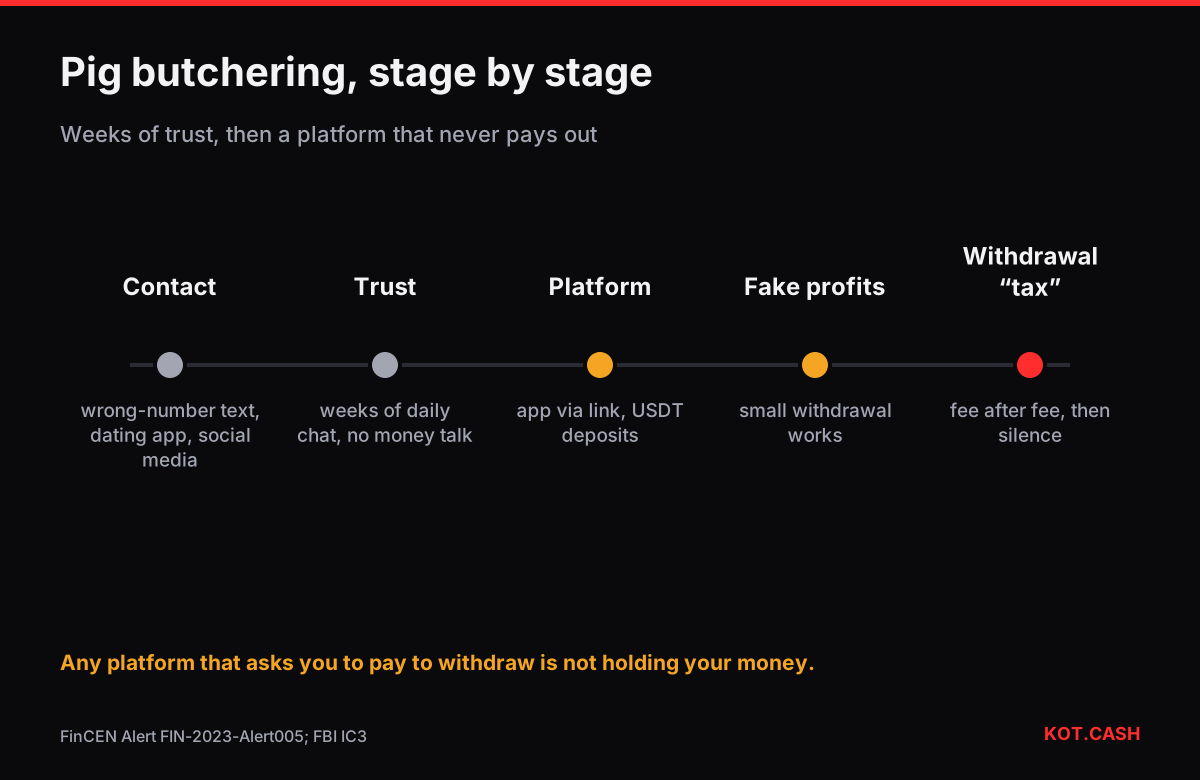
Pig butchering is a long investment scam: a stranger builds a friendship or romance over weeks, introduces you to a “trading platform” that shows impressive profits, lets you withdraw a little to earn trust, then blocks every larger withdrawal behind “taxes” and “fees” until you stop paying. The platform is fake, the profits are numbers on a screen, and the deposits went straight to the scammers. The name comes from the scammers’ own slang for fattening a pig before slaughter.
The stages
Every case differs in detail, but the order of stages is remarkably stable. Recognising which stage you are in is the fastest way out.
- Contact. A “wrong number” text, a dating-app match, a LinkedIn or Instagram message, a member of a hobby group. The person is attractive, successful and patient.
- Trust. Weeks of daily conversation, photos of travel and food, talk about family. Money is not mentioned at first.
- The hook. They mention an uncle, a mentor or an insider who trades crypto “with a secret strategy”, and show screenshots of profits.
- The platform. You are guided to install an app or open a website — often a clone of a real exchange, or an app distributed through a link rather than a store. You buy USDT on a real exchange and send it to the “platform”.
- Proof. Your balance grows quickly. A small withdrawal works, which removes doubts.
- Fattening. You are encouraged to deposit more — savings, loans, money from relatives — for a “limited event” or a “VIP level”.
- Slaughter. A large withdrawal is blocked: you must first pay 10–30% “tax”, a “risk deposit”, or an “anti-money-laundering fee”. Each payment brings a new demand. Then the contact disappears.
How big the problem is
In its annual reports the FBI’s Internet Crime Complaint Center has listed investment fraud, most of it involving crypto, as the costliest category of reported internet crime, with losses of several billion dollars a year in the US alone. The US Treasury’s FinCEN issued an alert on pig butchering in September 2023 (FIN-2023-Alert005). A UN human rights report in 2023 described large scam compounds in South-East Asia where people trafficked into the region are forced to run these conversations. In November 2023 Tether announced it had frozen about $225 million in USDT linked to a network of this kind, working with an exchange and US law enforcement.
Red flags
- A stranger who keeps talking after a “wrong number” and steers to investing.
- Refuses video calls or always has a reason why the camera is broken.
- A platform you cannot find in app stores, installed via a link, a TestFlight invite or an APK.
- Returns that are steady and high: 1–3% a day, “never a losing week”.
- A withdrawal that requires paying something first, to a separate address.
- Pressure to keep it secret from family “until you surprise them with the profit”.
Checking a platform someone recommended
- Paste its domain into the phishing link checker and look up when the domain was registered. Weeks-old domains for a “global” platform are typical.
- Search the platform name together with “scam” or “withdrawal”. Victims often post the same patterns.
- Check whether it is registered with your country’s financial regulator. Clone sites sometimes copy the licence number of a real firm; regulators publish warning lists of such clones.
- Try to withdraw everything you deposited, before depositing more. If the answer is a fee, stop.
If it is happening to you or someone close
- Stop sending money, including “one last” fee.
- Save the chats, usernames, phone numbers, platform domain and every deposit address and transaction hash.
- Report to the police and, in the US, to IC3 and the FTC; in the UK to Action Fraud. Report the deposit addresses to the exchange you sent from — exchanges can flag and sometimes freeze funds when they reach a regulated service.
- Expect recovery offers next and ignore them — see crypto recovery scams.
- If you are helping a relative, avoid shaming. Victims are often deeply attached to the contact; talking about how the platform works (deposits that cannot be withdrawn) is more effective than arguing about the person.
Where swaps fit in
Scammers usually tell victims to buy USDT on a real exchange or through a swap service and send it to an address they provide. The exchange or swap itself works correctly — the coins arrive where you sent them — which makes the fraud feel legitimate. KOT.CASH pays out to whatever address you enter, and the transfer cannot be recalled. If someone gave you a deposit address for a “trading platform”, read this article before you paste it as a payout address.
FAQ
Why could I withdraw at first?
Small early withdrawals are part of the scheme. They create trust before larger deposits.
The platform asks for tax before withdrawal. Is that normal?
No. Taxes are paid to the tax authority, not to the platform. A fee required to withdraw is the classic final stage of the scam.
Can the money be traced?
The deposits are on a public blockchain and can be traced; recovery is possible only if funds reach a service that freezes them at a police request.
Are these scams only romantic?
No. Many start as friendships, business contacts or investment groups on messaging apps.
How can I help a relative who does not believe it is a scam?
Suggest a full withdrawal test before any new deposit, and help them contact the police and their bank. Avoid blaming.