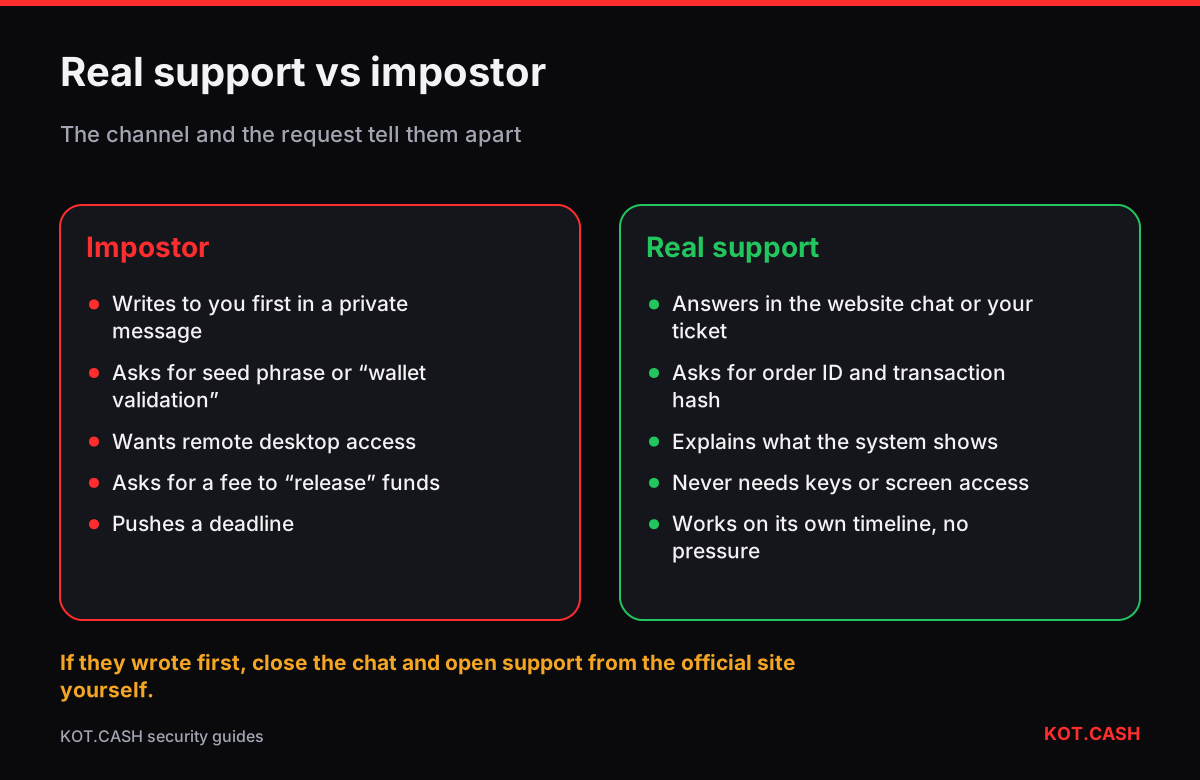
If someone offers you crypto support in a private message after you asked a question in a public chat, assume it is a scam. Real support teams of wallets, exchanges and swap services answer in the channel you contacted them through — a ticket, an in-app chat, an e-mail you wrote to — and none of them ever needs your seed phrase, private key or remote access to your computer. That single rule stops almost every impersonation attempt.
The typical script
You post in a project’s Telegram group: “my swap is pending” or “I can’t see my tokens”. Within a minute two or three accounts reply or write to you directly. Their names copy the project (“KOT.CASH Support”, “Admin | Help Desk”), they use the official logo, and sometimes a fake “ticket number”. The conversation moves quickly to one of a few endings:
- “Validate” or “synchronise” your wallet on a website — which asks for the seed phrase.
- Install a remote desktop tool (AnyDesk, TeamViewer) so the “agent” can “fix” the wallet.
- Send a small payment to unlock a stuck transfer, or a “gas fee” to an address they give you.
- Sign a transaction on a link that is actually an approval or a drainer signature — see wallet drainers.
Where impostors find you
Impostors read public places where people describe problems: Telegram and Discord groups of wallets and exchanges, replies under a project’s posts on X, Reddit threads, app-store reviews and even comments under YouTube tutorials. Bots scan these for words like “stuck”, “pending”, “lost”, “help” and answer within seconds, often faster than a moderator. Some groups are fake in their entirety: a copy of the official channel with the same name and pinned messages, where every “admin” is the scammer. A search-engine ad for “wallet support phone number” can lead to a call centre run by the same people.
The defence is to describe a problem only in the official support channel, and when you do ask in public, never post your address, order link or balance.
How real support behaves
Support teams work through channels they control. They can look up an order or a ticket by its ID, ask for a transaction hash, and tell you what the system sees. They have no button that fixes a blockchain transaction for a fee, and no reason to see your screen.
For KOT.CASH that means the chat on the website and support tickets. To look into an order, support needs the order link or ID and, if you have it, the hash of your deposit. Nothing else. Anyone asking for a seed phrase, a private key, a payment “to release funds” or remote access is not KOT.CASH.
Checks you can do in ten seconds
- Did you start this conversation in this exact channel? If they wrote first in a private message, close it.
- Open the official site by typing the domain or from a bookmark and find the support link there. Do not use a link the “agent” sent. The phishing link checker flags look-alike domains.
- Look at the account: a username that differs by one letter from the official one, a fresh account, hidden phone number, no history in the group.
- Watch for urgency: “your wallet will be suspended in 30 minutes”, “funds will be lost if you don’t act”. Blockchain transfers do not time out because of an admin.
Phrases that end the conversation
You do not have to argue. These answers are enough:
- “I’ll contact support through the official website.”
- “I don’t share my seed phrase or screen with anyone.”
- “Send the request through my ticket.”
Then block and report the account in the chat. Group admins remove impersonators faster when users report them, and it protects the next person.
If you already followed the instructions
- Gave a seed phrase? Move everything immediately from that wallet to a new wallet with a new seed, created on a clean device. The attacker may wait before draining, or may already have swept the funds.
- Installed remote access? Disconnect the computer from the internet, uninstall the tool, and treat every password and seed that was on the machine as exposed. Change exchange passwords and 2FA from another device.
- Signed something? Check and revoke token approvals on every network you use.
- Paid a “fee”? That payment cannot be reversed on-chain. Keep the hash and the chat logs, report to the police — IC3 in the US, Action Fraud in the UK — and to the platform where the impersonator contacted you.
FAQ
Does KOT.CASH support write to users in Telegram first?
Support answers you in the channel you used: the website chat or a ticket. Treat unsolicited private messages as impostors.
Will support ever need my seed phrase?
No. No legitimate support of any wallet, exchange or swap service needs it. A seed phrase gives full control of the funds.
What information is safe to give support?
The order ID or link, the transaction hash, the coin, network and amount, and the time you sent. All of these are public or harmless.
Is a verified badge proof of a real account?
No. Badges can be bought on some platforms and fake ones are drawn into avatars. Check the account against links on the official website.
Can a support agent cancel a blockchain transaction?
No one can cancel a confirmed transaction. Support can only check the order and, if the service received your funds, process a payout or refund under its rules.