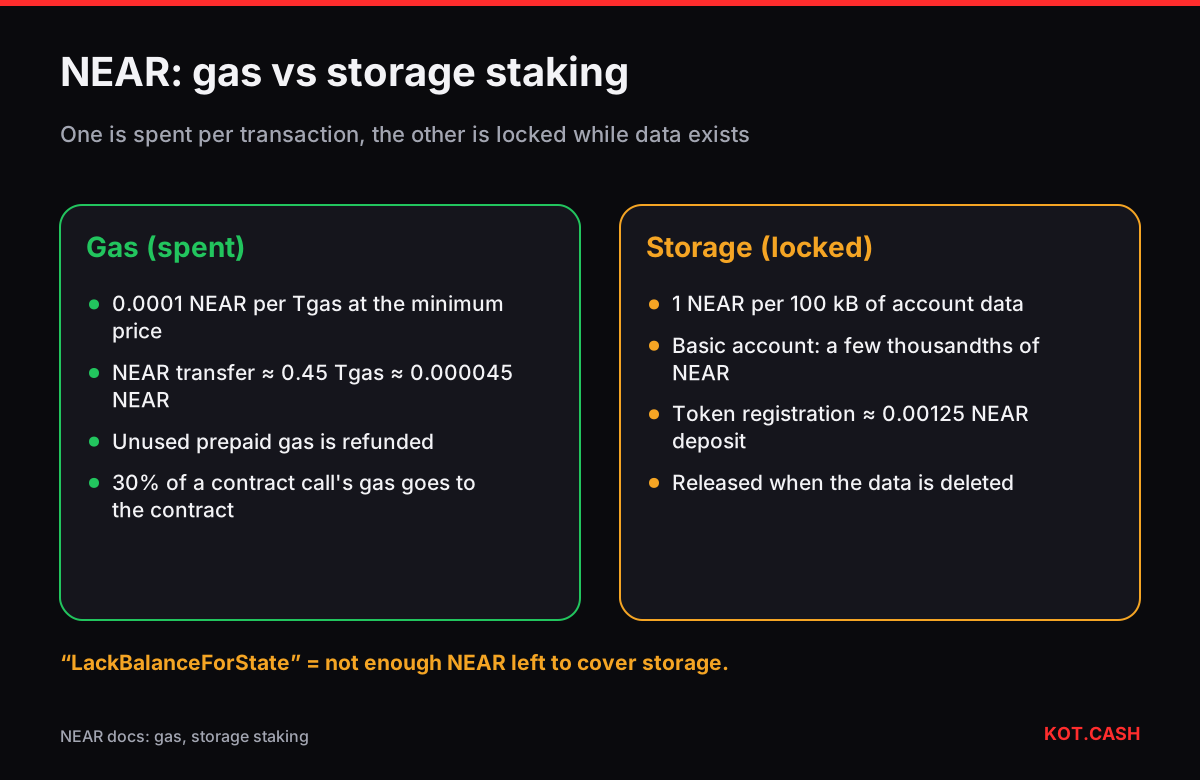
NEAR charges for two different things. Gas pays for computation, and it is cheap: the minimum gas price is 100 million yoctoNEAR per gas, which is 0.0001 NEAR per Tgas, so a simple NEAR transfer of under half a Tgas costs about 0.00005 NEAR. Storage staking pays for data your account keeps on chain: 1 NEAR must stay locked for every 100 kB stored (10^19 yoctoNEAR per byte). Storage NEAR is not spent, but it cannot be transferred while the data exists — which is why a wallet may show an available balance slightly lower than the total.
Units first
1 NEAR = 10^24 yoctoNEAR. Gas is counted in units of gas, usually written in teragas: 1 Tgas = 10^12 gas. Wallets and explorers convert everything for you, but when you read raw values the exponents matter; the unit converter handles yoctoNEAR exactly.
Gas: what a transaction costs
Every action — a transfer, a function call, creating an account — has a gas cost defined by the protocol, and the account pays gas × gas price. The gas price adjusts block by block with demand but cannot fall below the minimum, and in practice it stays there most of the time. Contract calls declare a gas limit (often 30–300 Tgas for complex calls); unused prepaid gas is refunded.
| Action | Gas | Cost in NEAR |
|---|---|---|
| NEAR transfer | ≈ 0.45 Tgas | ≈ 0.000045 |
| Token (NEP-141) transfer | ≈ 3–15 Tgas incl. receipts | ≈ 0.0003–0.0015 |
| Create a named sub-account | a few Tgas + storage | fee + locked storage NEAR |
| Complex DeFi call | 30–300 Tgas attached | ≈ 0.003–0.03, unused part refunded |
A distinctive NEAR rule: when a transaction calls a contract, 30% of the gas burned by that call is paid to the contract's account as a developer reward, and the rest is burned.
Storage staking: the locked part of your balance
Every account on NEAR occupies storage — the account record itself, access keys, and any contract data written on its behalf. The protocol requires the account to hold NEAR proportional to that storage: 1 NEAR per 100 kB, or 0.00001 NEAR per byte. A basic account with one full-access key uses a few hundred bytes, so its storage requirement is a few thousandths of a NEAR. Holding fungible tokens is different: each token contract stores your balance in its own storage and usually asks you to register with a small storage deposit (commonly 0.00125 NEAR) the first time you receive that token.
- Storage NEAR is locked, not spent: delete the data and it becomes available again.
- Token storage deposits are paid to the token contract and can be withdrawn when you unregister from the token.
- If your balance drops close to the storage requirement, transactions that add data fail with a “LackBalanceForState” error.
Named accounts and implicit accounts
NEAR has human-readable account IDs such as alice.near and implicit accounts whose ID is a 64-character hex string derived from a public key. An implicit account comes into existence when it first receives NEAR, much like an address on other chains. Exchanges commonly use implicit addresses for deposits; wallets let you create named accounts. Both are valid recipients. Since 2024 NEAR also supports 0x-style Ethereum-compatible implicit accounts for wallets like MetaMask, but not every service accepts them — when withdrawing, use the address format the service lists.
NEAR on KOT.CASH
The liquidity provider accepts NEAR on the native NEAR network and credits it after 5 confirmations. NEAR produces blocks about every second and finalises them within a couple of seconds, so deposits are credited quickly. The minimum for NEAR to USDT is about 6.1 NEAR at the moment, and the payout network fee is included in the quote. Use NEAR to USDT, and send from a wallet with a little NEAR left over so the account keeps covering its own storage.
Why NEAR transactions take more than one block
NEAR is sharded, and a transaction is converted into receipts that may execute on different shards. A transfer between two accounts usually completes within two blocks; a token transfer that calls a contract on another shard and then a callback can take three or four blocks. Explorers such as NearBlocks show the transaction and its receipts separately, and the transaction is successful only when the final receipt succeeds. If a token transfer looks “stuck”, open the receipts — a failed callback refunds the tokens to the sender.
Gas attached to a call is distributed across those receipts, which is why contract calls ask for more gas up front than they finally use; the remainder comes back to your account.
FAQ
How much does a NEAR transaction cost?
A simple transfer costs about 0.00005 NEAR at the minimum gas price; token transfers and contract calls cost more but still fractions of a cent.
What is storage staking on NEAR?
NEAR locked in your account to pay for the data it stores: 1 NEAR per 100 kB. It is released when the data is deleted.
Why can't I send my full NEAR balance?
Part of it covers your account's storage. The wallet shows the available balance after that requirement.
What is an implicit NEAR account?
An account whose ID is a 64-character hex public key. It is created automatically when it first receives NEAR.
How fast are NEAR deposits on KOT.CASH?
The provider waits for 5 confirmations, a few seconds.