A multisig wallet needs several keys to approve a transaction instead of one. In a 2-of-3 setup there are three keys, any two of which can spend; one key can be lost and the funds are still reachable, and one stolen key is not enough to steal them. That combination — tolerance to loss and to theft at the same time — is why multisig is the standard for company treasuries and a common choice for individuals holding large sums.
What m-of-n means in practice
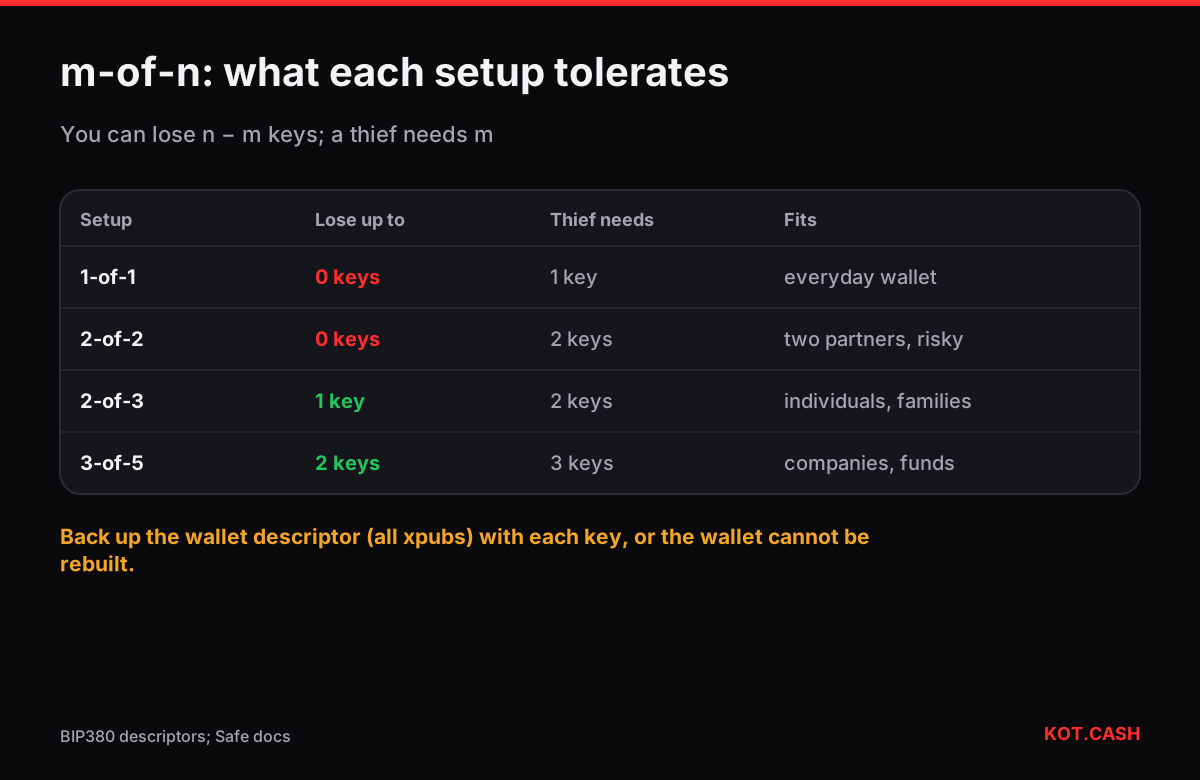
“m-of-n” says how many signatures (m) out of how many keys (n) a spend needs. The two numbers decide what can go wrong: you can lose up to n − m keys without losing access, and an attacker needs m keys to take the funds.
| Setup | Keys you can lose | Keys a thief needs | Typical use |
|---|---|---|---|
| 1-of-1 (normal wallet) | 0 | 1 | Everyday amounts |
| 2-of-2 | 0 | 2 | Two partners who both must agree; risky — one loss locks funds |
| 2-of-3 | 1 | 2 | Individuals and families: two devices + one backup key |
| 3-of-5 | 2 | 3 | Companies, funds, shared custody |
The multisig setup planner shows these numbers for any m and n and helps lay out where each key lives.
How multisig works on Bitcoin
Bitcoin supports multisig in its scripting system. Modern wallets use native SegWit multisig (P2WSH, addresses starting with bc1q and 62 characters long) or Taproot-based schemes. Wallets such as Sparrow, Electrum, Nunchuk and Specter coordinate the keys, which are usually held on hardware wallets from different vendors. Each key is a normal seed phrase with an extended public key (xpub).
The important detail: to rebuild a multisig wallet you need the wallet configuration, not just enough seeds. The configuration (an output descriptor) lists all n xpubs, their derivation paths and m. With two of three seeds but without the third xpub you cannot compute the addresses. Back up the descriptor — it is not secret enough to steal funds, but it reveals your balance, so store it privately with each key. See what is an xpub.
How multisig works on Ethereum and EVM chains
Ethereum accounts have one key, so multisig is a smart contract: the most widely used is Safe (formerly Gnosis Safe). The contract holds the funds and executes a transaction once m owners have signed it. A Safe is deployed per network; the same address on Ethereum and on Arbitrum may be separate contracts with separate owners, and sending tokens to a Safe address on a network where it is not deployed is a common, painful mistake.
A typical 2-of-3 layout for one person
- Key A — hardware wallet from vendor 1, kept at home, used for regular signing.
- Key B — hardware wallet from vendor 2, kept in a different place (office, relative, deposit box).
- Key C — seed phrase on steel only, stored in a third place; used if A or B is lost.
- Descriptor — a copy next to each key, plus one in a password manager or printed in the inheritance file.
Spending needs A and B together, so a thief who breaks into your home gets only A. Losing A in a fire is fixed with B and C. Using two vendors means a bug in one vendor’s firmware does not affect both signing keys.
What the Bybit theft showed
In February 2025 attackers took about $1.5 billion in ETH from a Bybit cold wallet protected by a Safe multisig. The FBI attributed the theft to North Korean hackers. The signers were not tricked into giving keys; the web interface they used was compromised, and it showed them a routine transfer while the data they signed changed the wallet’s contract logic. Multisig did its job — several people signed — but every signer trusted the same screen.
- Signers must verify what they sign on the hardware device or with an independent tool, not only in the web UI. The EIP-712 decoder helps read Safe transaction data.
- Avoid blind signing: a hardware wallet that shows only a hash protects the key, not the decision.
- Use different devices and, ideally, different software for different signers so one compromise does not reach all of them.
Is multisig worth it for you?
- Yes if a loss would change your life, if several people share responsibility, or if you want an heir to be able to recover funds with help from a trusted third key.
- Probably not for amounts you move often: every spend needs two devices, fees on Bitcoin are higher because the transaction is larger, and the setup must be documented.
- Simpler alternatives for single owners: a hardware wallet with a BIP39 passphrase stored separately.
Receiving from a swap into multisig
A Bitcoin multisig address is an ordinary address for the sender, so KOT.CASH can pay out BTC to a bc1q… multisig address like any other. For Ethereum Safes, check that the Safe is deployed on the network of the payout — for USDT on Ethereum that is Ethereum mainnet — before you paste the address. Then send a test transaction first if the amount is large.
FAQ
What is a 2-of-3 multisig?
A wallet with three keys where any two can sign a spend. One key can be lost and one can be stolen without losing the funds.
Do I need all seeds to recover a multisig?
You need m seeds plus the wallet configuration (descriptor) that lists all xpubs. Back up the descriptor with each key.
Are multisig transactions more expensive?
On Bitcoin yes, because they contain more signatures. On Ethereum a Safe transaction costs more gas than a plain transfer.
Can KOT.CASH send to a multisig address?
Yes, a multisig address is an ordinary destination. For Safe on EVM chains make sure the Safe exists on that network.
Does multisig protect against phishing?
Only if every signer checks what they sign independently. A compromised interface shown to all signers can still trick them.