You have received tokens on Ethereum and intend to send them onwards: some to another wallet and some to a service account. You hold enough of the tokens themselves, but ordinary outgoing transactions require a separate ETH budget. Checking that budget before the swap and subsequent distribution is more useful than discovering the shortfall when the wallet refuses the first transfer.
Receiving tokens and sending them later are separate actions
This guide concerns ordinary transactions from your own account on Ethereum mainnet. A displayed token balance does not automatically become an ETH balance. When the wallet requires ETH to pay for a network operation, holding USDT or another ERC-20 token does not by itself satisfy that requirement.
Sponsored operations, special wallets and other networks may behave differently. Establish which network you are using and who pays for the action. A centralized platform may impose its own withdrawal fee and rules; a calculation for an ordinary Ethereum wallet cannot replace those conditions.
| Budget | Purpose | How to check it |
|---|---|---|
| The token itself | The quantity you intend to send | The specific asset balance and selected network |
| ETH for the network | Paying for an ordinary outgoing transaction | The transaction parameters and ETH balance on that network |
| Your chosen buffer | Extra headroom above the educational plan | An explicit assumption, not a promise of execution |
Do not use one gas figure for every action
A simple ETH transfer and a token contract call are different operations. Obtain a gas estimate for the specific transaction rather than copying a number from someone else's example. When an application presents several steps, establish how many separate transactions it actually intends to submit.
An ordinary token transfer does not automatically require a preliminary approval for an unrelated contract. If an interface asks for an approval, inspect the purpose and the permission recipient. Do not grant a permission simply to satisfy this educational calculator: the calculator requires no signatures.
A maximum budget is not the final charge
For transactions using the EIP-1559 mechanism, this tool multiplies the gas limit by the maximum fee per gas. That gives an upper gas budget under the parameters you entered. The final charge depends on gas actually used and the effective gas price; the entire entered cap does not necessarily get spent.
Do not arbitrarily lower the gas limit to make the result look cheaper: an insufficient limit can prevent successful execution. Conversely, a large limit in the calculation does not establish that the operation will consume that much gas. You need an estimate for the particular wallet or application and an understanding of the selected transaction type.
An educational plan for two transfers
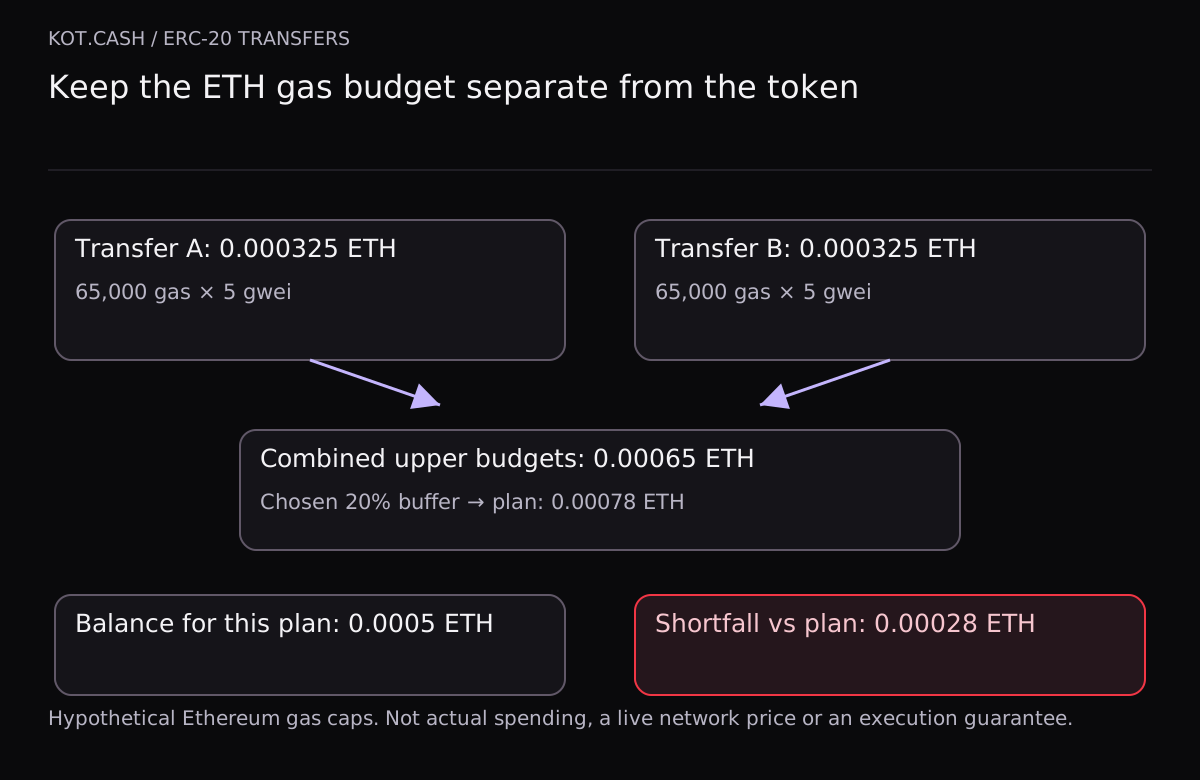
Suppose you have independently estimated two actions and assigned each a gas limit of 65,000 and a fee cap of 5 gwei per unit. These are hypothetical inputs, not a current recommendation for USDT or a promised network price. The upper budget for each action is 0.000325 ETH, or 0.00065 ETH for both.
Adding a chosen 20 percent buffer brings the plan to 0.00078 ETH. With an entered balance of 0.0005 ETH, the calculator reports an arithmetic shortfall of 0.00028 ETH against that plan. It does not advise buying exactly that amount: recheck the parameters, available balance and actual sequence before taking action.
Which actions belong in the list?
- List only the separate transactions you actually intend to perform.
- Use an individual gas limit and maximum fee estimate for each one.
- Remove completed actions and inspect pending transactions separately.
- Check ETH on Ethereum mainnet rather than a similarly named balance on another network.
Pending transactions can tie up part of the available budget. The calculator cannot see them: enter the amount available for your plan after making your own check. It also does not model transaction replacements, additional ETH transfers, platform withdrawal fees, special operations or charges on other networks.
Using the result when preparing a swap
First check where the tokens should arrive and what you intend to do with them afterwards. Then establish how those actions will be paid for. A low fee for the swap itself does not answer whether the receiving wallet can fund subsequent token movements.
Before sending funds on KOT.CASH, check the availability of the selected route, network, destination details and the conditions of the specific order. The service's public terms contain restrictions and variable exchange parameters. This guide does not replace checking your order or promise service availability in every country.
The tool runs locally. It requests no address, private key, seed phrase or wallet connection, reads no blockchain data and submits no transactions. An exported result records your assumptions at one moment. If the transaction parameters change, recalculate the plan rather than treating the old table as authorization to send.
Plan an ETH reserve for several ordinary transactions
Ethereum gas limit × maximum fee per gas upper budget only. Excludes ETH transfer value and other fees. Inputs are educational; no live estimates are retrieved. The calculation runs on your device; nothing you enter is sent anywhere.