USD1 is a US-dollar stablecoin launched in March 2025 by World Liberty Financial (WLFI), a crypto project publicly associated with members of the Trump family. Each token is intended to be redeemable 1:1 and is backed, according to the issuer, by short-term US government Treasuries, dollar deposits and cash equivalents held in custody by BitGo Trust Company. USD1 circulates on several networks; most of its supply and trading activity has been on BNB Smart Chain.
The facts that matter for a holder
| Question | Answer |
|---|---|
| Issuer | World Liberty Financial; reserves custodied by BitGo Trust Company |
| Reserves | Short-term US Treasuries, dollar deposits, cash equivalents (per issuer) |
| Reports | Monthly reserve attestations published by the issuer |
| Decimals | 18 on EVM networks — unlike USDT and USDC, which use 6 |
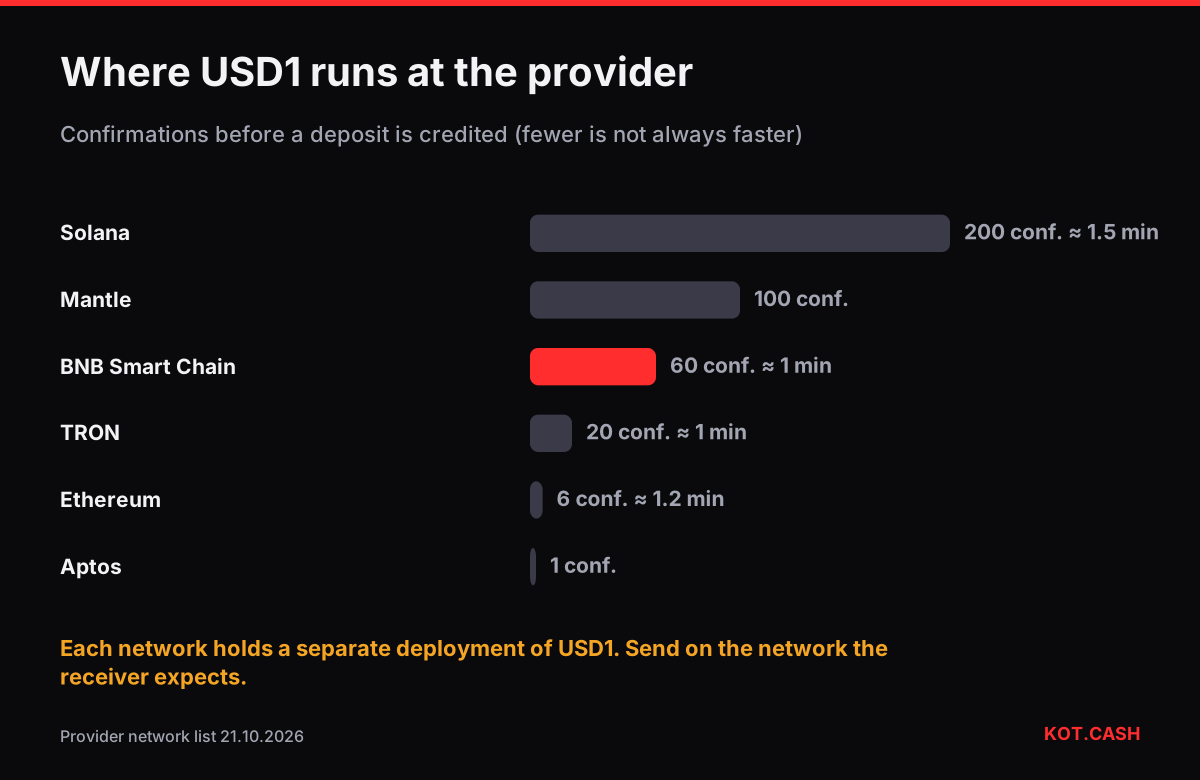
| Networks at the provider | BNB Smart Chain, Ethereum, Solana, TRON, Aptos, Mantle |
The 18 decimals on EVM chains are a practical detail: a raw value of 1000000000000000000 is 1 USD1. If you integrate USD1 or read raw logs, do not assume the 6 decimals familiar from USDT. The token decimals converter handles any precision.
Why it is controversial
USD1 attracted attention mainly because of who stands behind World Liberty Financial and because large institutional deals were settled in it shortly after launch. Critics have raised conflict-of-interest questions given the political links; supporters point to the custody arrangement with a regulated trust company and to published attestations. For a user, the practical questions are the same as for any issuer-backed stablecoin: how reserves are verified, who can redeem, whether addresses can be frozen and how liquid the token is on the networks you use.
Networks and fees
Because USD1 lives on several chains, the network choice decides the fee. On BNB Smart Chain a transfer costs a few cents in BNB; on Ethereum it can cost dollars; on TRON it burns TRX for energy like USDT TRC20; on Solana the fee is a fraction of a cent in SOL. The token on each chain is a separate deployment: USD1 on BNB Smart Chain sent to an address that expects USD1 on Ethereum will not appear there. The network fee comparison shows current costs per network.
- BNB Smart Chain: 0x address, gas in BNB, 60 confirmations at the provider.
- Ethereum: 0x address, gas in ETH, 6 confirmations.
- TRON: T… address, energy or burned TRX, 20 confirmations.
- Solana: base58 address, token account rent on first receipt, 200 confirmations.
Swapping USD1
The liquidity provider supports USD1 for deposits and payouts on the networks above. On 21.10.2026 the quoted minimum for USD1 on BNB Smart Chain to USDT TRC20 was about 30 USD1, credited after 60 BSC confirmations, with a payout network fee of about 1.3 USDT. The usual service fee applies (1% float, 1.5% fixed). Stable-to-stable swaps are useful when you need to change the token and the network at once — for example USD1 on BNB Smart Chain to USDT on TRON for an exchange that does not list USD1.
- Select USD1 and the network you hold it on.
- Select the coin and network you want, for example USDT TRC20 or USDC on Base.
- Paste the payout address, create the order and send exactly the amount shown.
- Check the payout hash on the order page in the receiving network's explorer.
How to verify the token you hold
Because USD1 is popular, copies with the same ticker exist on every chain. Open the token in your wallet, copy its contract address and compare it with the list on World Liberty Financial's official site, then search the address on BscScan, Etherscan, Tronscan or Solscan. The genuine token has a large holder count and a verified contract; a copy usually has a handful of holders and was created recently. Never add a token from a link received in a chat or from an airdrop: unknown tokens that appear in a wallet on their own are a common bait for phishing sites.
Reserve attestations are published monthly. When you read one, check the date of the snapshot, the total supply it covers and whether the reserve figure is equal to or above the circulating supply across all networks combined.
Risks worth weighing
- Issuer and governance concentration. The token depends on one issuer and one custodian, like most fiat-backed stablecoins.
- Freeze functions. Issuer-backed stablecoins on EVM chains typically include blacklist or freeze controls; check the contract on the explorer.
- Liquidity outside BNB Smart Chain. Pools on other chains may be thinner, which affects swap prices for large amounts.
- Regulatory status. Treatment differs by jurisdiction; in the EU, dollar stablecoins offered to the public need a MiCA-authorised issuer.
FAQ
Who issues USD1?
World Liberty Financial issues USD1; the reserves are custodied by BitGo Trust Company, according to the issuer.
What backs USD1?
Short-term US Treasuries, dollar deposits and cash equivalents, according to the issuer's attestations.
Which networks is USD1 on?
The provider lists BNB Smart Chain, Ethereum, Solana, TRON, Aptos and Mantle.
How many decimals does USD1 have?
18 on EVM networks, unlike USDT and USDC with 6. Check the contract for each network.
Can I swap USD1 to USDT on KOT.CASH?
Yes. On 21.10.2026 the minimum from USD1 on BNB Smart Chain was about 30 USD1.