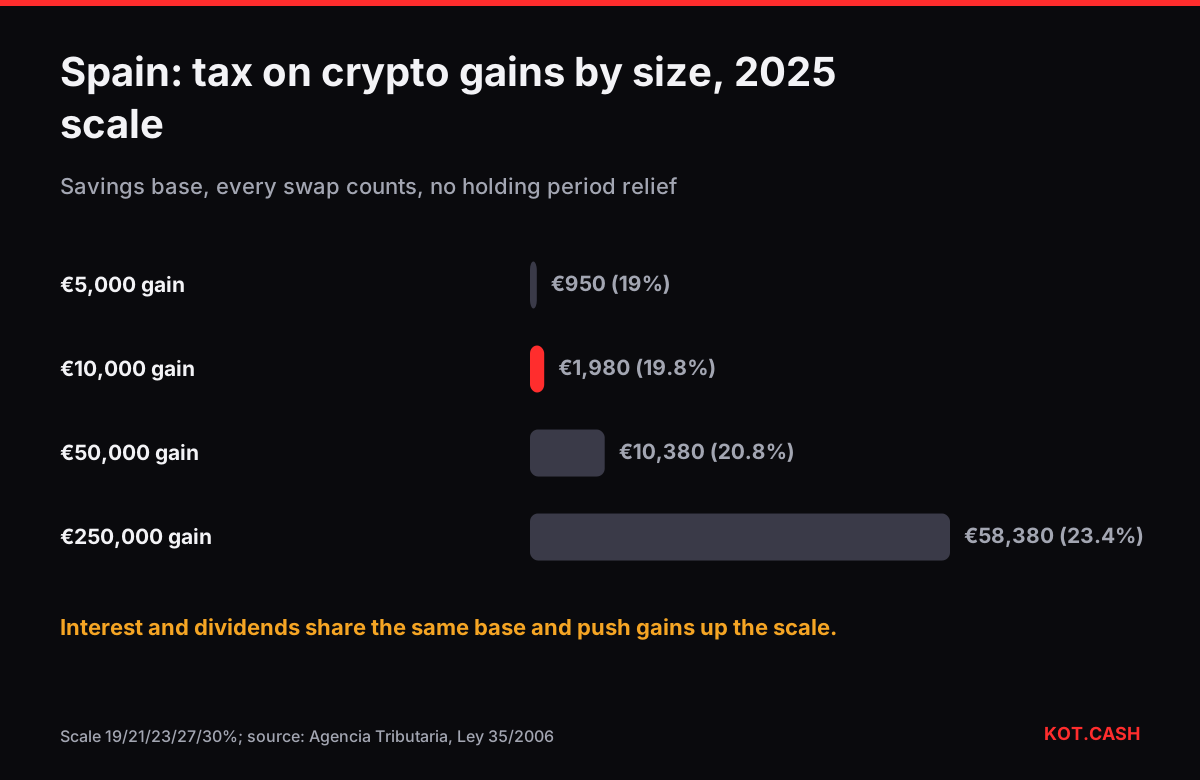
Spain taxes crypto gains of residents through personal income tax (IRPF) as capital gains in the savings base (base imponible del ahorro). The rates rise in five steps from 19% to 30% for 2025 income. Every disposal counts, including a swap of one crypto for another, which the Spanish tax agency treats as a permuta. Holding period does not matter: a coin held for five years is taxed exactly like one held for five days.
The savings scale
| Taxable savings income | Rate on that slice |
|---|---|
| up to €6,000 | 19% |
| €6,000 – €50,000 | 21% |
| €50,000 – €200,000 | 23% |
| €200,000 – €300,000 | 27% |
| over €300,000 | 30% |
The scale is progressive by slices. A net gain of €10,000 pays 19% on the first €6,000 (€1,140) and 21% on the next €4,000 (€840), €1,980 in total, an effective 19.8%. The top bracket rose from 28% to 30% for income from 2025. Interest and dividends share the same base, so they push your crypto gains up the scale. The Spain crypto tax calculator runs the slices for you.
Why a crypto swap is taxable
In binding consultations since 2018, the Directorate General of Taxes (DGT) has held that exchanging one cryptocurrency for another is a permuta under article 37.1.h of the IRPF law. You are treated as having transferred the first coin at the market value of the coin you receive. A gain or loss arises on the first coin, and the new coin takes that market value as its acquisition cost.
- BTC to ETH: taxable gain or loss on the BTC.
- ETH to USDT: taxable on the ETH. A stablecoin is another crypto-asset, not euros.
- USDT to euros: taxable on the USDT, usually a tiny gain or loss.
- Moving coins between your own wallets: not a transfer, no tax.
That is stricter than Portugal, Austria or Italy, where coin-to-coin swaps are neutral. See the cross-country comparison.
The rule also covers paying for goods with crypto and receiving a token through a DeFi exchange. In each case the question is the same: what was the euro value of what you gave up, and what did it cost you originally.
FIFO for identical coins
For homogeneous assets, article 37.2 of the IRPF law requires that the units sold are the ones acquired first. The DGT applies this first in, first out rule to cryptocurrencies. You cannot choose to sell the most expensive lot to reduce the gain. The cost of each lot includes purchase fees; sale fees reduce proceeds. The tax lot calculator shows the FIFO matching.
Losses
Capital losses offset capital gains within the savings base in the same year. If losses remain, they can reduce other savings income such as interest and dividends by up to 25% of that income, and what is left carries forward for four years. Losses from coins bought back shortly after a sale can be challenged under the anti-avoidance rules for homogeneous assets, so harvesting losses by selling and immediately rebuying is risky in Spain.
Staking, lending and mining
The DGT has treated staking rewards as income from movable capital (rendimientos del capital mobiliario), taxed in the savings base at their market value when received. Lending interest is treated the same way. Mining done as an organised activity is an economic activity taxed in the general base at progressive rates. The value you were taxed on becomes the cost of the reward coins for later sales.
Reporting obligations beyond IRPF
| Form | What it is | When it applies |
|---|---|---|
| Modelo 100 | annual income tax return | gains and crypto income of the year |
| Modelo 721 | information on crypto held abroad | balance over €50,000 at 31 December |
| Modelo 714 | wealth tax | if your net wealth exceeds the regional threshold |
| Modelo 172 / 173 | filed by providers in Spain | your balances and operations are reported for you |
Modelo 721 is informative: it does not create tax, but missing it carries penalties. It covers crypto held with providers outside Spain; self-custody is a grey area that many advisers file anyway to be safe. The income tax campaign runs roughly from April to the end of June for the previous year.
Records for every swap
Because every swap is taxable, you need the euro value of both sides of each one. For a non-custodial swap on KOT.CASH, save the order link: it shows the amounts sent and received and both transaction hashes. Pair it with the euro price of each coin at that minute from a consistent source. A year of active trading can easily mean hundreds of lines on the return.
FAQ
What is the crypto tax rate in Spain?
Gains are taxed in the savings base at 19% up to €6,000, then 21%, 23%, 27% and 30% above €300,000 for 2025 income.
Is swapping crypto for crypto taxable in Spain?
Yes. The tax agency treats it as a permuta: the coin you give up is sold at the market value of the coin you receive.
Does holding crypto longer reduce tax in Spain?
No. There is no holding period exemption or discount for crypto.
What is Modelo 721?
An information return for crypto held with providers abroad when the balance exceeds €50,000 at 31 December.
How are staking rewards taxed in Spain?
The DGT has classed them as income from movable capital in the savings base, at market value when received.