Two swap forms display receiving amounts of 480 and 479 units. The first number is larger, but is that enough to compare them? One sender separately spends some of the source asset on the transfer, while the other incurs a different expense. Looking only at the amount sent to the service can compare unequal total costs and suggest a conclusion the quotes do not establish.
Choose one comparison boundary
The boundary used below is the sender's total expenditure in the source asset. It consists of the amount that must reach the service plus an additional expense in that same asset that is not already included. The receiving side is calculated separately in its own asset.
Every row must describe the same direction: the same source and destination assets, the intended networks and a comparable transfer purpose. The tool does not identify an asset from its symbol or verify a network. Establish those conditions before entering amounts; equal numbers alone do not make two swaps equivalent.
| ID | Send to service | Additional source expense | Total expenditure | Quoted receiving amount | Unaccounted output deduction | Calculated remainder |
|---|---|---|---|---|---|---|
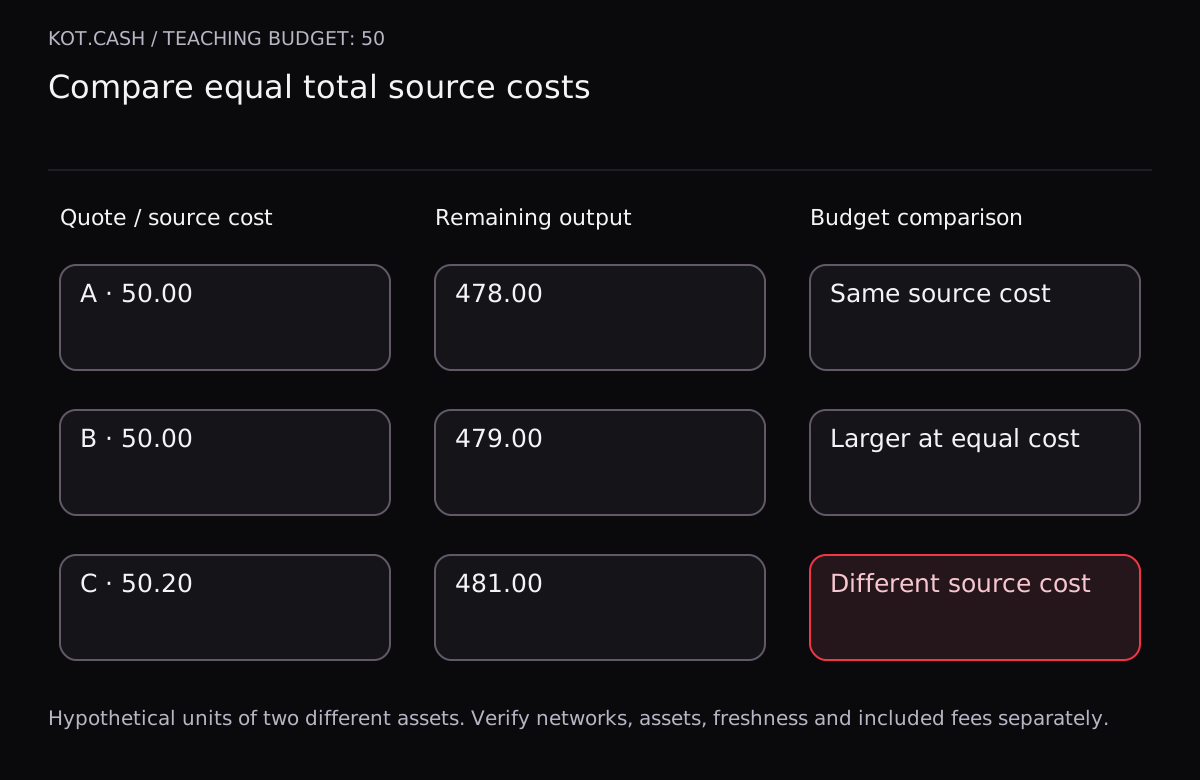
| A | 49.90 | 0.10 | 50.00 | 480.00 | 2.00 | 478.00 |
| B | 49.80 | 0.20 | 50.00 | 479.00 | 0.00 | 479.00 |
| C | 50.00 | 0.20 | 50.20 | 481.00 | 0.00 | 481.00; unequal cost |
Quotes A and B spend exactly the selected 50 units. After the separately entered deduction, B leaves a larger receiving amount. C offers more again but requires 50.20. It cannot be called the better quote for a budget of 50 without obtaining a new quote. The letters identify teaching records, not actual services or KOT.CASH offers.
Zero additional deductions can be more accurate than subtracting twice
An additional fee means only an expense not yet accounted for in the selected quote field. If the displayed receiving amount already includes a payout network expense, subtracting it again distorts the result. The KOT.CASH fees page describes service expenses as included in the rate and network expenses as included in the receiving calculation. Check the current form for an individual order's conditions.
The additional output deduction field therefore does not imply that receiving always requires a separate charge. It is deliberately nonzero in teaching row A. Enter zero when no unaccounted deduction exists, and clarify the meaning of an unfamiliar field before using it.
Why the tool does not scale the quote proportionally
Dividing C's receiving amount by 50.20 and multiplying by 50 would produce a number, not a newly executable quote. Minimum amounts, expense rules and the offer itself can change at another volume. Instead of making that assumption, the form marks the row as not matching the budget.
Enter up to twelve rows and the precisions of the two assets, from zero to eighteen decimal places. Decimal amounts are converted to integer atomic units. Extra decimal places cause an error rather than silent rounding. An output deduction cannot leave a negative receiving amount; that input is rejected.
What the maximum result means
Among rows whose total source expenditure exactly matches the chosen budget, the form finds the largest remaining receiving amount. It lists every corresponding ID when results tie. If no row matches, there is no maximum: unequal costs are not hidden behind an approximate comparison.
This is a numerical check of supplied records. It does not assess a service's reliability, direction availability, quote freshness, slippage, price-hold period or actual execution. A larger calculated amount is not, by itself, a recommendation to send funds.
Information to retain alongside the amounts
Record when the quote was obtained, its expiration, the precise networks and assets, the source of each fee amount and whether it is included. An estimated expense or upper bound should not be presented as a known actual cost. A final comparison needs consistent information; this local form cannot discover whether conditions changed after copying.
Before exchanging through KOT.CASH, inspect the current form, direction and order conditions. Use this calculation to notice unequal expense boundaries or a fee counted twice. It creates no order, reserves no rate, sends no transaction and does not confirm actual receipt of funds.
Compare receiving amounts at an exact source budget
Teaching records for one independently verified direction. Additional expenses use their own asset and must not already be included. Up to 12 rows; exact values up to 10^30 atomic units. No conversion between expense currencies, asset/network checks, freshness, reliability assessment, live quotes or execution. The calculation runs on your device; nothing you enter is sent anywhere.